European Cities Don’t Feel More Walkable Because They’re Older. They Feel More Walkable Because of Decisions Made in the 1970s
We may earn money or products from the companies mentioned in this post. This means if you click on the link and purchase the item, I will receive a small commission at no extra cost to you ... you're just helping re-supply our family's travel fund.
American visitors to European cities routinely attribute the walkability difference to age — European cities predate the automobile, the assumption goes, so of course they’re built for walking. That explanation is only partially true and misses the more important story: many European cities, particularly in the Netherlands, actively bulldozed and rebuilt car-centric infrastructure they’d constructed in the mid-20th century, choosing deliberately, through specific policy fights in the 1970s, to reverse course and rebuild around pedestrians, cyclists, and public transit instead.
The Dutch case that proves it was a choice, not an accident
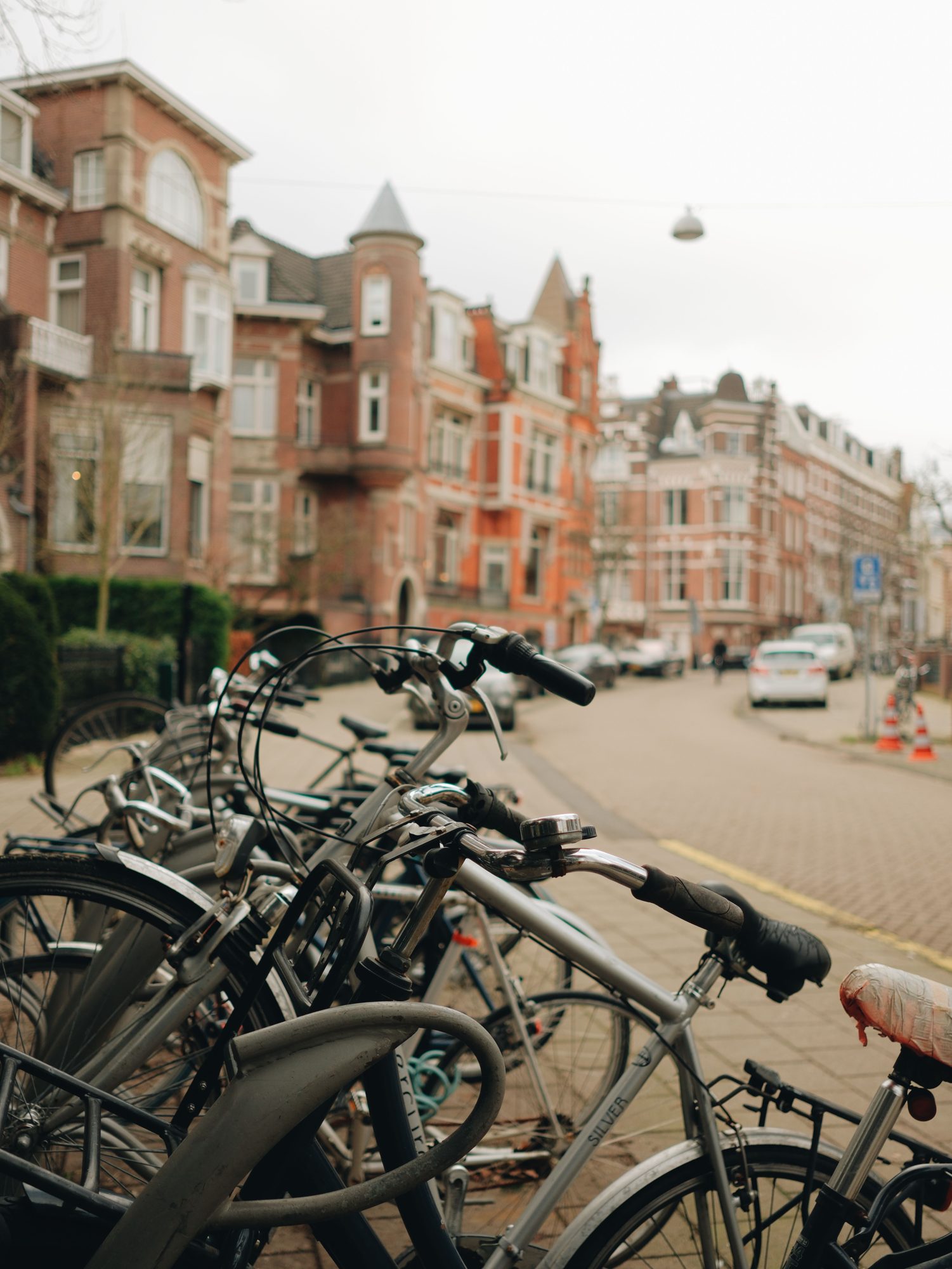
The Netherlands in the 1950s and 60s was rapidly motorizing, building car infrastructure and widening roads through historic city centers in Amsterdam, Utrecht, and elsewhere, following largely the same American-influenced planning philosophy dominating Western urban policy at the time. Rising traffic deaths, especially of children — a movement called Stop de Kindermoord, “Stop the Child Murder,” emerged in the early 1970s specifically in response to the death toll — combined with the 1973 oil crisis, which made car-dependent infrastructure suddenly look like a strategic vulnerability, produced a genuine political turning point. Dutch cities began systematically narrowing streets, building protected bike infrastructure, and restricting car access to historic centers over the following decades, a process that took thirty-plus years of sustained policy commitment rather than happening automatically because the cities were old.
That history matters because it directly contradicts the common American assumption that walkability is simply an inherited medieval-street-grid accident. Plenty of European cities with equally old cores, particularly in parts of the UK and southern Europe, remained far more car-dependent through the late 20th century and only began pedestrianizing more recently, in some cases well behind the Netherlands’ curve, proving that the underlying street age was never the determining factor on its own.
Barcelona’s superblock initiative, which restricts through-traffic within designated multi-block zones to create pedestrian-priority interior streets, offers a newer, ongoing example of the same deliberate policy approach applied at a neighborhood scale rather than city-wide, and the program has drawn significant academic and urban-planning interest specifically because it demonstrates the Dutch-style intervention model can be adapted incrementally, neighborhood by neighborhood, rather than requiring the kind of sweeping, decades-long national commitment the original Dutch transformation took to complete.
The specific policy tools that produce the walkable feeling
Beyond bike infrastructure, European cities widely use tools American cities rarely deploy at the same scale: congestion pricing that charges drivers to enter city centers, as London and Stockholm have run for years with measurable traffic reduction results; strict parking minimums removed or reversed, making it deliberately harder and more expensive to store a car in dense areas; and zoning that mixes residential, retail, and office uses on the same block, rather than the single-use zoning that dominates American suburban and even much urban development, which forces car trips between separated zones for even basic errands. Public transit investment in most major European cities also receives a level of sustained government subsidy that most American transit systems have never approached, making trains and buses genuinely competitive with driving on both cost and convenience rather than a fallback option for people without cars.
Why American cities haven’t followed the same path
- Post-war American suburban development and highway expansion were federally subsidized at a scale with no European equivalent
- Single-family zoning remains dominant across most American cities, legally preventing the dense, mixed-use development walkability requires
- Local political resistance to removing parking or car lanes is intense in most American cities, even when data shows minimal traffic impact
- American transit agencies generally operate with far less consistent, guaranteed public funding than European counterparts
What this means for American cities trying to change
Paris’s more recent pedestrianization push under Mayor Anne Hidalgo, including the closure of a major Seine riverside expressway to car traffic and an ambitious citywide bike lane expansion completed over the past decade, demonstrates that this kind of large-scale infrastructure reversal isn’t limited to smaller Dutch cities — it’s been successfully replicated in a major world capital with far higher car traffic volume, proving the policy playbook scales even in cities where car culture had been deeply entrenched for generations before the political will to reverse it finally emerged.
A small but growing number of American cities have started borrowing directly from the Dutch playbook — protected bike lane networks in cities like New York and Chicago, and pedestrian-only street pilots in several downtowns — and while none has approached the scale of European car-restriction policy, the fact that any of it is happening at all demonstrates the same underlying point the Dutch history proves: walkability is a policy outcome, achievable within a few decades given sustained political will, not a fixed characteristic tied permanently to a city’s age or its street grid’s original design.
Copenhagen’s transformation followed a broadly similar timeline to the Dutch cities, with the city closing its main shopping street, Strøget, to car traffic in 1962 as an initial experiment that proved unexpectedly popular and set off decades of subsequent pedestrian and bike infrastructure expansion, reinforcing the same underlying lesson that Northern European walkability emerged through a specific, traceable sequence of political decisions rather than simply persisting unchanged from medieval street layouts.
Vienna’s investment in an affordable, dense public transit network alongside strict limits on new car infrastructure offers yet another variant of the same underlying policy story, reinforcing that no single Northern European country holds a monopoly on this approach.