The Oregon Coast Has Nothing in Common With Portland. Visitors Keep Assuming It Does
We may earn money or products from the companies mentioned in this post. This means if you click on the link and purchase the item, I will receive a small commission at no extra cost to you ... you're just helping re-supply our family's travel fund.
Portland’s national reputation — liberal politics, food carts, tech workers, a certain quirky urban identity — has almost nothing to do with the towns strung along Oregon’s roughly 360-mile Pacific coastline, a two-to-four-hour drive from the city depending on which stretch a traveler is headed toward. Astoria, Newport, and Brookings each carry their own distinct, working-class, maritime character shaped far more by fishing, logging, and, increasingly, tourism than by anything resembling Portland’s urban culture, and visitors who arrive expecting a beachy extension of Portland’s identity are consistently surprised by how different the coast actually feels.
Astoria’s fishing-port identity, still largely intact
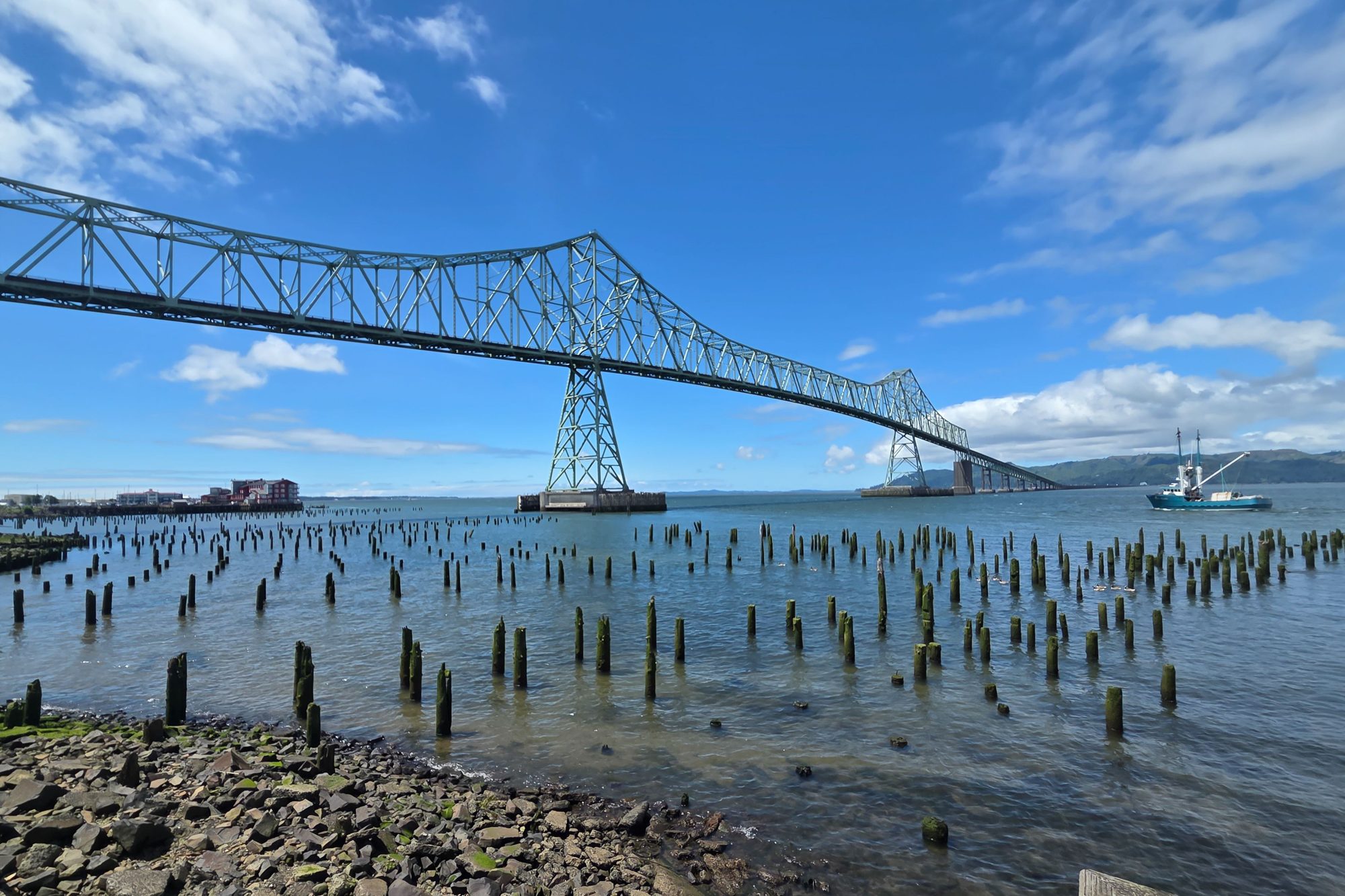
Astoria, at the mouth of the Columbia River where it meets the Pacific, was Oregon’s first American settlement, established in 1811 as a fur trading post, and it retains a genuine working waterfront built around commercial fishing and Columbia River shipping traffic that gives it a distinctly different feel than a purely tourist-oriented beach town. The city gained a specific pop-culture profile as the filming location for The Goonies in 1985, and the house used in the film remains a genuine, if now heavily managed, tourist stop, drawing visitors decades after the movie’s release in numbers that occasionally frustrate the private homeowners nearby. Astoria’s steep hills and Victorian-era architecture, a legacy of its early wealth from the fishing and timber industries, give it a visual character closer to a small Pacific Northwest San Francisco than anything resembling coastal Oregon’s more typical low-rise beach towns.
Newport’s split identity between tourism and working harbor
Newport, roughly in the middle of the Oregon coast, operates one of the state’s most active commercial fishing ports, and its bayfront district deliberately maintains a mix of working fish-processing operations alongside tourist-facing restaurants and shops, a combination that gives visitors genuine, unstaged access to a functioning commercial fishing economy rather than a museum version of one. The Oregon Coast Aquarium, based in Newport, gained early fame for housing Keiko, the orca who starred in the Free Willy films, before his eventual release attempt, and remains one of the coast’s most significant tourist draws independent of the fishing industry itself. Sea lions congregating loudly on the docks near the bayfront’s processing plants have become one of Newport’s most reliable, if unglamorous, free attractions, drawing crowds simply by being audibly, visibly present in numbers.
Weather represents another significant, often underappreciated difference between the coast and Portland, since coastal Oregon experiences a genuinely different, more persistently foggy and wind-driven climate pattern than Portland’s interior valley location, with towns like Newport recording some of the foggiest conditions on the entire West Coast during summer months, a detail that surprises visitors expecting the sunny beach weather that summer travel marketing often implies for coastal destinations generally, regardless of latitude or specific microclimate.
Brookings and the coast’s southern, warmer microclimate
Brookings, near the California border, benefits from a specific microclimate effect locals call the “Brookings effect,” where warm, dry winds descending from the Siskiyou Mountains occasionally push winter temperatures into the 70s, an anomaly that’s made the town a genuine, if lesser-known, winter escape for Oregonians seeking warmth without leaving the state. The town’s economy leans more heavily on agriculture, particularly Easter lily bulb production — Brookings and the neighboring California border town of Smith River together grow the vast majority of the nation’s Easter lily bulbs — than on the fishing and timber identity that defines Astoria and Newport further north.
What ties all three towns together despite their differences
- All three sit on Oregon’s entirely public beach coastline, a policy dating to the state’s 1967 Beach Bill guaranteeing public access to the entire shore
- Commercial fishing, whether currently thriving or in decline, shaped each town’s original economy and remains visible in the built environment
- None of the three has the population density, traffic, or urban amenities that would make them feel like coastal extensions of Portland
- All three depend heavily on summer tourism income to sustain businesses through Oregon’s long, wet off-season
Why the Portland comparison keeps coming up anyway
Oregon’s coastal economy has had to adapt significantly as the timber industry that once sustained many of these towns declined sharply from its mid-20th-century peak, driven by a combination of automation, reduced federal timber sales, and environmental protections for old-growth forest habitat. Tourism has filled part of that economic gap in towns like Astoria and Newport, but not entirely, and coastal Oregon communities continue to have measurably lower median incomes than Portland and the Willamette Valley, another concrete way the coast’s economic reality diverges from the state’s dominant urban center.
Most out-of-state visitors’ only prior reference point for Oregon at all is Portland, since it’s the state’s dominant media presence and largest city by a wide margin, which makes it the natural, if inaccurate, mental anchor for anyone planning a first coastal Oregon trip. The coast’s fishing-town, working-class character, shaped by industries and weather patterns entirely disconnected from Portland’s urban economy, means visitors who do their research beyond a quick Portland-adjacent assumption tend to have a much better calibrated, more rewarding trip, arriving expecting small maritime towns with real, unpolished character rather than a beach version of a city hundreds of miles and an entirely different economic world away.
Highway 101, running the length of the coast, remains the primary connective thread between Astoria, Newport, and Brookings, and driving its full length has become its own recognized road trip tradition among Pacific Northwest travelers, distinct from any single town’s individual identity.