California’s Largest State Park Covers About 650,000 Acres of Desert. 8 Things to See at Anza-Borrego This Winter
We may earn money or products from the companies mentioned in this post. This means if you click on the link and purchase the item, I will receive a small commission at no extra cost to you ... you're just helping re-supply our family's travel fund.
Anza-Borrego Desert State Park is the largest state park in California, covering roughly 650,000 acres of desert in eastern San Diego County and parts of Imperial and Riverside counties. That is bigger than many national parks. It includes about 500 miles of dirt roads, 12 wilderness areas, palm oases, slot canyons, and badlands that look like another planet.
It also has an ideal season. In summer, temperatures can top 110 degrees. In winter, highs often sit in the 60s and 70s, nights are cool and clear, and the desert becomes one of the most pleasant places in Southern California to spend a weekend.
The park takes its name from Juan Bautista de Anza, the Spanish explorer who crossed this desert in 1774, and “borrego,” the Spanish word for sheep, a nod to the Peninsular bighorn sheep that live in its mountains. The small town of Borrego Springs sits in the middle of the park. Here are eight things to see there this winter.
8 Things to See at Anza-Borrego Desert State Park
1. Borrego Palm Canyon
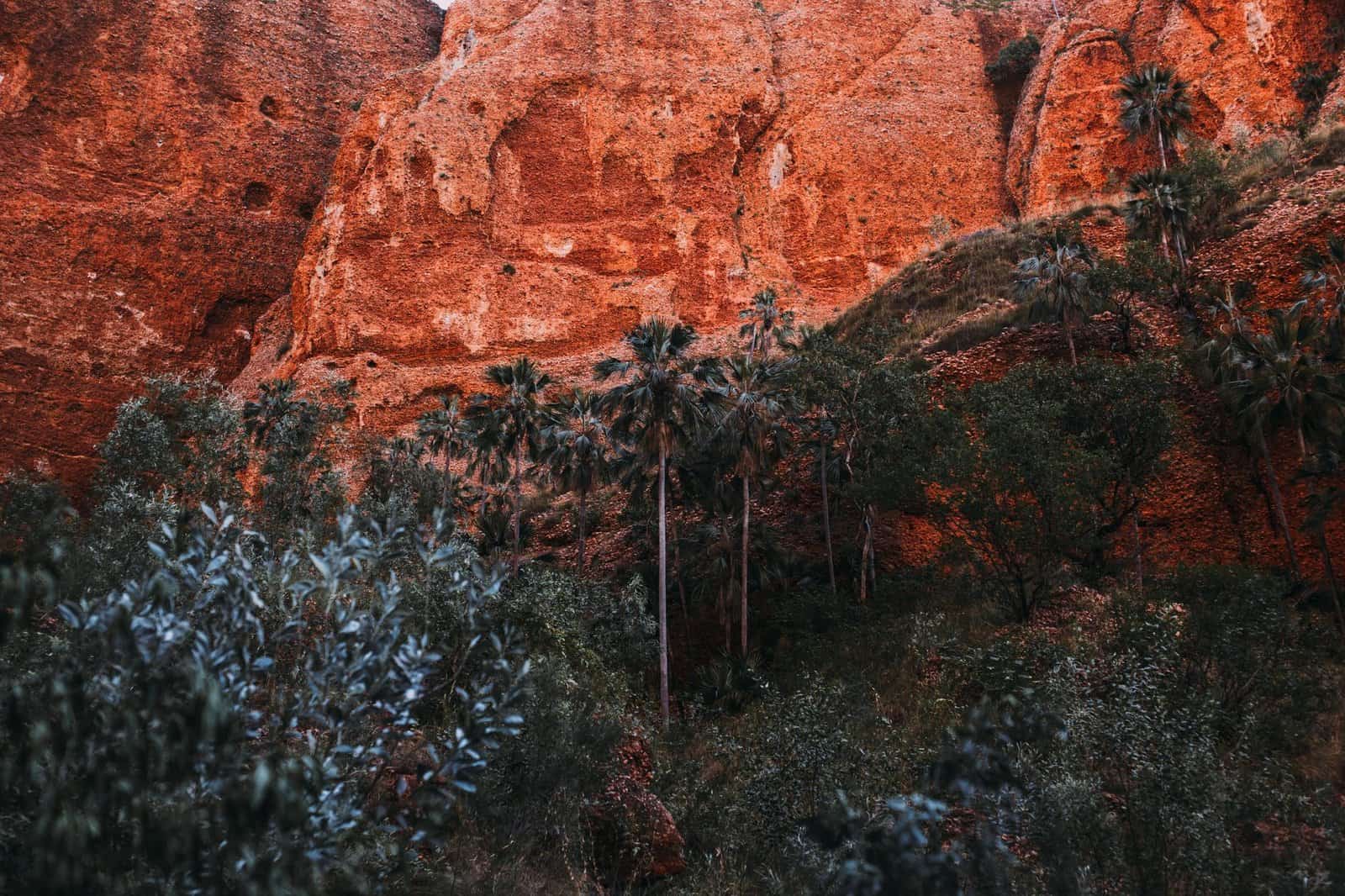
Borrego Palm Canyon is the park’s signature hike. The trail starts near the main campground and climbs gradually up a rocky canyon to a grove of California fan palms, the only palm native to the state. It is about 3 miles round trip, with modest elevation gain.
In winter, a small stream often runs through the canyon, especially after rain, and the palm oasis feels surprisingly lush against the bare rock. The canyon is also one of the best places in the park to spot Peninsular bighorn sheep, an endangered population. Look up at the rocky slopes, especially early in the morning. A day-use parking fee applies at the trailhead.
2. The Visitor Center
The park’s visitor center, just west of Borrego Springs, is built partly underground to stay cool. It has exhibits on desert ecology, geology, and the park’s fossil record, plus a short desert garden walk outside with labeled plants.
Stop here first. Rangers can tell you which dirt roads are passable, what is blooming, and where sheep have been seen recently. The park’s backcountry roads change after storms, so current information matters.
3. The Galleta Meadows Metal Sculptures
Scattered across the open desert around Borrego Springs are more than 130 large metal sculptures by artist Ricardo Breceda. They depict prehistoric animals that once lived here, like mammoths, saber-toothed cats, and giant sloths, alongside horses, a desert serpent that appears to swim through the sand, and historical figures.
The sculptures sit on private land called Galleta Meadows, open to the public. You can drive to most of them on paved and dirt roads. They are especially striking at sunrise and sunset, when the metal glows against the mountains.
4. Font’s Point
Font’s Point overlooks the Borrego Badlands, a maze of eroded ridges and gullies that change color as the light moves. Many visitors call it one of the best viewpoints in Southern California.
Reaching it requires driving a sandy dirt road, roughly 4 miles off the paved highway. Conditions vary, and high-clearance vehicles are often recommended. Ask at the visitor center first. Sunset here is spectacular.
5. The Slot
The Slot is a narrow sandstone canyon off a dirt road near the eastern part of the park. A short trail drops into a passage that gets so tight in spots you have to turn sideways. Walls rise high above you, carved into wavy shapes by flash floods.
It is a fun, short hike for most ages. Avoid it if rain is in the forecast anywhere upstream, since slot canyons can flood suddenly.
6. The Borrego Springs Night Sky
Borrego Springs was named California’s first International Dark Sky Community in 2009. The town limits outdoor lighting to protect the night sky, and the surrounding park has very little light pollution.
In winter, long nights and dry air make stargazing excellent. The Milky Way is less prominent in winter than in summer, but you can still see dense star fields, constellations like Orion, and sometimes the zodiacal light. Pull off at a dark spot outside town, let your eyes adjust for 20 minutes, and look up. Local businesses and astronomy groups sometimes host star parties.
7. The Elephant Trees and Split Mountain
In the southeastern part of the park, Split Mountain Road leads to two sights worth a half day. The Elephant Trees nature trail, a short loop, passes rare elephant trees, a desert species with thick, swollen trunks. Farther on, Fish Creek Wash leads through Split Mountain, a gorge with towering walls of folded sedimentary rock, and to the Wind Caves, sandstone formations carved by wind.
Fish Creek Wash is sandy and best for high-clearance or four-wheel-drive vehicles. Check road conditions before heading in.
8. Early Wildflowers and Bighorn Sheep
Anza-Borrego is famous for its spring wildflower blooms, which usually peak in late February and March after a wet winter. In dry years, the bloom is thin. In wet years, it can carpet the desert floor in color and draw huge crowds.
Even in December and January, you may see early blooms, especially desert lavender, chuparosa, and ocotillo leafing out after rain. Ocotillo turns green and sometimes produces red tips after storms. Combine flower watching with bighorn spotting in canyons like Borrego Palm Canyon and around Coyote Canyon.
The Fossils Under Your Feet
Anza-Borrego holds one of the richest fossil records in North America. Sediments in the badlands preserve millions of years of history, from times when the area was a sea, then a land of rivers and grasslands. Researchers have found remains of mammoths, ancient horses, camels, saber-toothed cats, and giant ground sloths here, which is why Breceda’s sculptures feature those animals.
Collecting fossils in the park is illegal, and the park’s paleontology program works to protect them. You can see displays at the visitor center and learn about ongoing research. If you spot something that looks like a fossil on a hike, photograph it, note the location, and leave it in place.
A Two-Day Winter Itinerary
- Day one morning: visitor center, then Borrego Palm Canyon while temperatures are cool.
- Day one afternoon: drive the sculpture loops around Borrego Springs.
- Day one evening: sunset at Font’s Point if road conditions allow, then stargazing outside town.
- Day two morning: The Slot, then a picnic.
- Day two afternoon: Split Mountain Road, the Elephant Trees loop, and Fish Creek Wash if you have the right vehicle.
That plan covers the park’s highlights without rushing, though you could spend weeks exploring its backcountry roads and canyons.
When to Visit Anza-Borrego
The best season runs from about November to April.
- November and December: comfortable temperatures, few crowds.
- January and February: cool nights, occasional storms, possible early blooms.
- March: peak wildflower season in good years, with the biggest crowds.
- April: temperatures start climbing; bloom moves to higher elevations.
Even in winter, the sun is strong. Bring sunscreen, a hat, and plenty of water.
Getting There and Getting Around
Borrego Springs is about two hours northeast of San Diego and about two and a half hours from Los Angeles, depending on traffic. The drive in, down steep mountain grades like Montezuma Grade, is part of the experience, with views over the desert.
A regular car can reach the visitor center, Borrego Palm Canyon, many sculptures, and other paved-road sights. Font’s Point, The Slot, and Fish Creek Wash are reached by dirt roads that change after storms. Ask a ranger or rent a high-clearance vehicle if you plan to explore.
Where to Stay
- Borrego Palm Canyon Campground: the park’s main developed campground, with tent and RV sites. Reservations are recommended in winter.
- Primitive camping: allowed in much of the park, following park rules.
- Borrego Springs: a small town of about 3,000 residents with a handful of resorts, inns, motels, and rentals. Winter rates are higher than summer.
Gas, groceries, and restaurants are available in town, but options are limited. Fill up before heading into the backcountry.
Bighorn Sheep Etiquette
Peninsular bighorn sheep are federally listed as endangered, and the park is one of their strongholds. If you see them on a trail, stop, stay quiet, and watch from a distance. Do not approach or follow them. Dogs are not allowed on most park trails, partly to protect wildlife, so check the rules before bringing a pet.
Desert Safety in Winter
Winter is the mild season, but the desert still demands respect.
- Carry at least a gallon of water per person per day.
- Tell someone your plans if you head onto backcountry roads.
- Watch for flash floods during storms, even far away.
- Do not rely on cell service in canyons and remote areas.
- Stay on established roads to protect fragile desert surfaces.
- Do not disturb fossils, artifacts, or plants.
Why Anza-Borrego Is Worth the Trip
Many Californians drive past the desert on the way to somewhere else, or head straight for Joshua Tree. Anza-Borrego is quieter and wilder, and it rewards people who take time to explore. In a single winter weekend, you can hike to a palm oasis, squeeze through a slot canyon, watch the sun set over badlands, and see a sky full of stars. That is a lot to ask from 650,000 acres, and the park delivers.