Best Ways to Travel From Bangkok to Chiang Mai
We may earn money or products from the companies mentioned in this post. This means if you click on the link and purchase the item, I will receive a small commission at no extra cost to you ... you're just helping re-supply our family's travel fund.
For the quickest trip, fly; for the scenery, take the daytime train; and for a group sharing the fare, consider a private driver on the Bangkok to Chiang Mai route. Your choice depends on whether speed, views, overnight travel, low cost, or group comfort matters most. Flights cut travel time, while the daytime train gives you a better look at the countryside and mountains. A private van with a driver can suit several people splitting one vehicle’s cost.
The five options differ in comfort, cost, and how much of your day they use. Your trip priorities can help you narrow the choices before you compare schedules and prices. Treat every fare as approximate and check it for your travel dates.
Key Takeaways
- Fly when convenience and a shorter travel day matter most.
- Take the daytime train when you want to see the mountains.
- Choose the sleeper train to travel overnight with a bed.
- Compare bus services for a budget overland trip.
- Consider a van with a driver when your group can share the fare.
Five Ways to Make the Trip at a Glance
The five choices differ most in how they use your time, what you see, and whether you share the trip. Each option suits a different kind of Bangkok Chiang Mai travel plan, so begin with the tradeoff you care about most.
Flights favor speed, while the daytime train favors views. The sleeper train combines transport with a bed, a bus can keep costs down, and a van with a driver gives your group private travel.
Match each option to its main advantage
The table gives you a quick way to compare the five options without mixing up their main strengths. Think about whether you want to arrive sooner, watch the route unfold, or travel together.
| Option | Main advantage | Main tradeoff | Best fit |
|---|---|---|---|
| Flight | Shortest travel day | Airport time and baggage costs | Travelers who value convenience |
| Daytime train | Views of countryside and mountains | A long day aboard | Scenery-focused travelers |
| Sleeper train | Travel and a bed in one trip | Much of the route passes in darkness | Overnight travelers |
| Bus | Budget-friendly overland travel | Many hours seated onboard | Cost-conscious travelers |
| Van with a driver | Private travel for a group | Whole-vehicle cost | Groups wanting flexible stops |
Compare the tradeoffs that matter
For a solo traveler, a shared bus fare may feel easier to manage than paying for a private vehicle. A group may see the van differently once everyone divides its total cost. The train choices also offer distinct trips: one gives you daylight views, while the other lets you lie down.
Compare more than the ticket price. A low fare may still mean a long day, and a quick flight still includes airport travel and check-in.
Choose the option by the thing you would most regret losing: time, scenery, a bed, a low fare, or privacy.
The table is a starting point, not a fixed ranking. Prices and comfort can vary across services, so use it to focus your next comparison. Use the table to narrow your shortlist by the one priority that matters most.
Flying for the Shortest Journey
A nonstop flight takes an average of 1 hour 22 minutes, while the complete trip takes about 4-5 hours once airport travel and check-in are included. Flying is the quickest way to travel Bangkok to Chiang Mai when you count the whole airport day.
Allow at least 2 hours before departure for domestic check-in and security. Your total travel time also includes getting to the airport in Bangkok and leaving Chiang Mai International Airport after landing.
Flight time and the airport-day calculation
A Bangkok to Chiang Mai flight takes about 82 minutes in the air on average. The 4-5-hour estimate covers airport travel and check-in as well as the flight, so it gives a more useful view of the day.
Direct service runs from Suvarnabhumi and Don Mueang to Chiang Mai International Airport. Airlines serving the route include Nok Air, Thai AirAsia, Thai Lion Air, Bangkok Airways, and Thai Airways.
Use this short checklist while comparing tickets:
- Confirm which Bangkok airport the ticket uses.
- Check the baggage allowance against the fare.
- Leave at least 2 hours for domestic check-in and security.
Fares, baggage, and choosing an airport
Budget around ฿1,000-3,000 per person for a flight. One-way fares on Trip.com start at $40 on selected dates, and the price depends on the date and baggage.
A low headline fare may cover less baggage than you need. Check the ticket terms before comparing it with another airline’s offer, especially if you plan to bring a checked bag.
Suvarnabhumi and Don Mueang are separate Bangkok airports, so the airport name matters when you plan your departure. The ticket will also name Chiang Mai International Airport for arrival.
Compare the baggage allowance as well as the headline fare before choosing a flight.
The Daytime Train for Countryside and Mountain Views
For travelers who want to watch the landscape change, Train 7 crosses rice fields, towns, and villages before climbing into the mountains. This daytime train is the scenery-first choice on the Northern Railway.
Train 7 is the only Bangkok-to-Chiang Mai service that crosses the mountains in daylight. Its scheduled journey takes 10 hours 20 minutes, making the route itself a major part of the trip.
What you see along the Northern Railway
The train leaves the central plain and passes farmland, rice fields, towns, and villages. The view shifts as the route moves north, with more hills and mountain slopes appearing along the way.
The climb into the northern mountains is the key reason to choose this service over other trains. Train 7 crosses that section in daylight, so you can watch the terrain change from your seat.
It is a long day on the rails, but the changing views give the travel time a clear purpose. If the mountain section matters to you, check that you are choosing Train 7 rather than an overnight service.
Seat price and scheduled journey
An air-conditioned second-class seat costs 858 THB online or 558 THB at a station in Thailand. Those are different prices for the same seat class, so note which way you plan to buy.
The scheduled ride lasts 10 hours 20 minutes. Bring something to read or do between the more scenic stretches, since the trip includes many hours of travel beyond the mountain views.
The daytime service works best when the passing landscape is part of what you want from the trip. Choose the daytime service when seeing the mountain section matters more than arriving sooner.
The Sleeper Train for Overnight Travel
Train 9 is scheduled to run overnight for 12 hours 35 minutes, combining the journey with a bed. The sleeper train suits travelers who value rest onboard more than views along the way.
A classic second-class air-conditioned sleeper berth starts at 793 THB. That fare was verified November 7, 2026; the approximate range for an air-conditioned berth is ฿800-1,100 THB.
Air-conditioned berth and first-class choices
A second-class sleeper gives you an air-conditioned berth for the overnight ride. The fare can change with the berth and booking details, so use the stated range as a planning figure rather than a guaranteed quote.
A first-class sleeper has a private two-bed room, a wash basin, and a door that closes. Expect to pay about 1,700-2,000 THB for this room option.
The State Railway of Thailand opens sleeper reservations 90 days ahead. That window matters if you want a particular class or room, especially when your dates are set well in advance.
The tradeoff between sleep and scenery
Sleeping onboard can save the cost of a hotel night, since the train covers ground while you rest. You arrive after spending the night on the train rather than booking a separate room for that night.
Much of the scenery on earlier Bangkok-to-Chiang Mai sleeper trains passes while it is dark. The dark mountain views on sleeper trains make this a weaker choice if watching the route is central to your plans.
Think about the bed as part of the transport, not as a way to see the full route. Choose a sleeper for the overnight rest and lodging savings, not for uninterrupted mountain views.
The Bus as a Budget Alternative
A bus is the budget alternative, with an approximate fare of ฿600-1,000 THB and a journey of around 10-11 hours. This low-cost option works for travelers who are comfortable spending a long stretch onboard.
Both the bus fare and journey time depend on the service. Different operators may offer different comfort levels, schedules, and prices, so compare the trip details rather than assuming every bangkok bus takes the same time.
Some travelers choose a bus because it offers a direct overland ride without the cost of a private vehicle. The chiang mai bus route can be a practical fit when keeping your travel budget tight matters more than having extra room.
For another view of how travel costs can shift by comfort level, see this Thailand travel budget breakdown. It can help you place the bus fare alongside other spending during a trip.
Check what the selected service includes before you buy tickets. A lower price may suit your plans, while a different service may offer features that matter more during a long ride.
For comfort on a lengthy trip, think about how well you manage sitting for hours and whether you want to sleep while traveling. The bus is a shared ride, so you will follow its route and scheduled stops.
Compare the service’s fare and scheduled duration for the date you plan to travel.
A Van With a Driver for Groups
A private van can suit a group that wants door-to-door travel and can divide the vehicle cost. It offers private group travel, with room to plan stops along the route.
Budget approximately ฿10,000-12,000 THB for the whole van, or about ฿1,670-2,000 THB per person for six people. Allow around 10-12 hours with breaks, depending on how the day unfolds.

Whole-vehicle and per-person budgeting
The per-person estimate assumes six people divide the van fare. Compare that split with the whole-vehicle price, since the group size changes what each traveler pays.
MEKHE lists a Toyota Commuter for the one-way Bangkok-to-Chiang Mai route at 14,500 THB per vehicle. Its listing gives a route distance of 695 km, which provides a specific quote to compare with the broader planning range.
MEKHE lists gasoline, drinking water, expressway tolls, and government taxes as included. Read the quote closely to see which costs apply to your own booking.
Door-to-door service and planned stops
A van with a driver can pick up your group and take you to your chosen destination, rather than requiring a shared terminal transfer. MEKHE describes its service as private, door-to-door transport.
MEKHE asks passengers to provide planned stops when booking. Sightseeing detours may cost extra, so tell the provider what you want to visit before agreeing to a quote.
Use this checklist when arranging the vehicle:
- Confirm passenger count.
- Give planned stops.
- Clarify which costs are included.
- Ask how sightseeing detours affect the quote.
For six travelers, compare the per-person split with the private vehicle’s total quoted price.
Best Way to Travel From Bangkok to Chiang Mai by Priority
Fly for convenience, take the daytime train for scenery, and consider a private driver when several people can share the cost. These are distinct choices, each aimed at a different trip priority.
The best way to travel Bangkok to Chiang Mai depends on what you want the trip to give you. Convenience points toward flying, views favor the daytime train, and a group may value a private ride.
Choose flying for convenience
Choose a flight if you want to spend less of the day traveling between the cities. The airport steps still take planning, but the short time in the air makes flights a strong fit when convenience comes first.
This choice makes sense if you would rather spend your time in Chiang Mai than watch the road or rail route. It is also a clear option when you have limited days for the trip.
Choose the daytime train for scenery
The daytime train is the strongest match when you want the journey itself to include countryside and mountain views. Choose it for the chance to watch the route change as the train heads north.
That means giving up a faster arrival in exchange for an overland experience. It is a choice for travelers who see the passing landscape as part of the trip, not as time to get through.
Consider a private driver for a group
A private driver may suit several people who want to travel together and share the cost of a van. Your group can arrange a door-to-door ride and plan stops, with any detour costs confirmed in advance.
The group size matters because the cost is split among the passengers. If flexibility and traveling together matter more than the cheapest individual fare, compare a private quote with other options.
Convenience, views, and group cost-sharing point to different choices. Make the final choice around the priority you would most regret giving up.
Departure and Arrival Points for Each Option
The departure point depends on the mode, so check the terminal name before heading across Bangkok. Your ticket details should match the airport or station you plan to reach.
Flights use two Bangkok airports, while trains and buses leave from named city terminals. Confirm the departure and arrival points for your option before setting out.
Airports and rail stations
Flights depart from Suvarnabhumi Airport or Don Mueang International Airport and arrive at Chiang Mai International Airport. Trains use Krung Thep Aphiwat Central Terminal Station in Bangkok and arrive at Chiang Mai station.
Check the full rail station name on your booking. Bangkok’s central terminal name is long, so taking a moment to match it can prevent a trip to the wrong place.
Bus terminals
Buses depart from Mo Chit, Bangkok’s northern bus departure point, and arrive at Arcade Bus Station in Chiang Mai. The table keeps the station and airport names together for quick reference.
| Mode | Bangkok departure point | Chiang Mai arrival point | Useful location name |
|---|---|---|---|
| Flights | Suvarnabhumi Airport or Don Mueang International Airport | Chiang Mai International Airport | Bangkok airports |
| Trains | Krung Thep Aphiwat Central Terminal Station | Chiang Mai station | Krung Thep Aphiwat |
| Buses | Mo Chit | Arcade Bus Station | Mo Chit and Arcade |
The airport or station listed for departure can change how you cross Bangkok before travel. Match the station or airport on your booking to the correct departure point.
Overland Stops Between the Two Cities
Travelers with extra days can break the overland trip into stops instead of going directly to Chiang Mai. The route gives you access to historical sites and local towns, with different character at each stop.
Sukhothai is off the Northern Railway Line, so reaching it involves a bus. New Sukhothai and the historical park are about 12 km apart, which adds a local transfer to that stop.
Central Thailand stops
Ayutthaya is known for the remains of its former royal capital, while Lop Buri has a long history and its own local character. Both can add a historical stop before you continue north.
These destinations suit travelers who want to see more than the endpoint. Leave room in your plans to explore rather than treating each town as a quick break between rides.
Northern stops and the Sukhothai connection
Farther north, Phitsanulok and Lampang offer more places to pause. Phitsanulok can work as a northern city stop, while Lampang brings a different setting before Chiang Mai.
Sukhothai calls for extra planning because it is not on the Northern Railway Line. You need a bus to reach it, and the New Sukhothai town area is about 12 km from the historical park.
Possible stops include:
- Ayutthaya
- Lop Buri
- Phitsanulok
- Sukhothai
- Lampang
Plan enough time for local transfers when a stop is away from the rail line. Allow itinerary time for the transfer between New Sukhothai and its historical park.
Booking Tickets and Berths
For a sleeper berth, start planning around the State Railway of Thailand’s 90-day reservation window. That early window gives you a clear point to work backward from when setting up an overnight trip.
Sleeper reservations open 90 days ahead. For buses, you can buy tickets at a station, arrange them through your hotel or hostel, or book online.
Reserve sleeper berths ahead
Start checking for a sleeper berth once your travel date falls within the reservation window. The time frame is useful if you want a particular sleeping class or first-class room.
Before you pay, make sure the berth type matches the way you plan to travel. A first-class room and a second-class berth provide different levels of privacy.
Choose a booking route for buses and flights
Bus tickets can be bought at a station, arranged through accommodation, or booked online. Each route gives you a way to set up the trip, whether you prefer to handle transport yourself or ask your hotel or hostel.
For a flight, use the airline or booking service that fits your plans, then read the ticket details closely. The airport name matters because Bangkok has two departure airports serving this route.
Check the date, class, departure point, and arrival point on every ticket before you set off. A small mismatch can send you to the wrong airport or station.
Keep a copy of the ticket details where you can find them during travel. Check the departure and arrival points on the ticket before leaving for the station.
Add Airport Access Time to the Flight Plan
The airport transfer is part of the flight day, so include it when weighing the total trip. The ground leg can differ based on which Bangkok airport your ticket names.
Suvarnabhumi and Don Mueang each sit outside central Bangkok, while Chiang Mai’s airport is about 2 miles from downtown. The times below are approximate and can help you plan both ends of the flight.
Getting to Bangkok’s airports
Suvarnabhumi Airport is about 19 miles from central Bangkok. The trip takes about 35 minutes by car or public transport.
Don Mueang is about 15 miles from central Bangkok. Its trip takes about 35 minutes by car or 1 hour 5 minutes by public transport.
Those estimates show why the airport name affects the ground leg before your flight. Pick the travel plan that matches the airport on your ticket, not just the city name.
Reaching the city from Chiang Mai airport
Chiang Mai International Airport is about 2 miles from the city center. A car takes about 15 minutes, while public transport takes about 25 minutes.
| Airport | Distance from city center | Approximate car time | Approximate public-transport time |
|---|---|---|---|
| Suvarnabhumi Airport | About 19 miles from central Bangkok | About 35 minutes | About 35 minutes |
| Don Mueang International Airport | About 15 miles from central Bangkok | About 35 minutes | About 1 hour 5 minutes |
| Chiang Mai International Airport | About 2 miles from Chiang Mai city center | About 15 minutes | About 25 minutes |
Travel times can shape how much room you leave between a ground transfer and your flight. Allow for the ground transfer to the specific airport printed on your ticket.
Prepare for a Long Journey
A few small preparations can make a long ride easier, especially when the air conditioning is running overnight. Pack for cool cabin air and keep the things you may need close at hand.
Thai night buses have air conditioning, and many offer water and stop for food or toilets. Newer buses may also have charging ports, though features can differ by service.
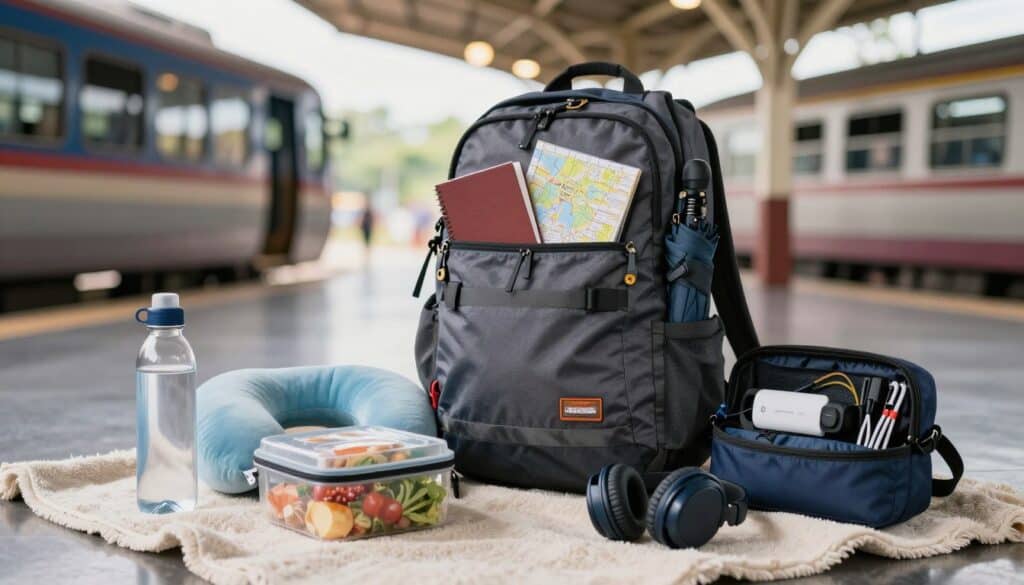
Use this short checklist for a bus or train ride:
- Bring a light layer for air conditioning.
- Pack a travel pillow.
- Carry snacks and tissues.
- Keep valuables with you rather than in stored luggage.
Small comfort items can make it easier to settle in for a long stretch of travel. A light layer is useful when cabin air feels cooler than expected, while a pillow can support your head during rest.
Snacks and tissues are handy when you want something within reach between stops. For more ideas on staying comfortable during a long bus ride, read these long-distance bus travel tips.
Check your seat area before you settle in, and keep essentials somewhere you can reach without opening stored bags. Keep valuables in your carry-on bag so they stay with you during the trip.
Keep your passport, cash, phone, and other valuables beside you, not in luggage stored away from your seat.
Conclusion
Choose the option that best fits your priority: speed, scenery, or sharing a private ride with a group. Fly for convenience, take the daytime train for views, or consider a private driver when several people can share the cost.
Prices are approximate and can change with your travel dates and chosen service. Check the latest fare for your travel dates before booking.