Tens of Thousands of Snow Geese Winter in Washington’s Skagit Valley. Here’s Where to See Them
We may earn money or products from the companies mentioned in this post. This means if you click on the link and purchase the item, I will receive a small commission at no extra cost to you ... you're just helping re-supply our family's travel fund.
Every fall, white geese pour out of the sky over the farm fields north of Seattle. Watching the Skagit Valley snow geese come in, tens of thousands at a time, is one of the great free wildlife shows in the Pacific Northwest, and you can do it from the side of a farm road.
The short answer to where: start at the Fir Island Farm Reserve and Wylie Slough on Fir Island near Conway, then cruise the farm roads of Fir Island and the Skagit Flats west of Mount Vernon and La Conner, where flocks feed in harvested fields. Those spots, all within about an hour of Seattle, put you in the heart of the wintering grounds.
The geese arrive around late October and stay until about March or early April. Local estimates commonly put the Skagit flock at 50,000 or more birds in a good year, many of them from a breeding colony on Wrangel Island, off the coast of Russia’s far northeast. Late fall and early winter, when the flocks have settled into their daily routine, is a strong time to go.
Here’s Where to See Them
Snow geese spend their nights on the tide flats and bays of Skagit and Port Susan, then fly inland during the day to feed on leftover crops and winter cover in farm fields. That means the flock moves. A field that is full of geese at 9 a.m. may be empty by lunch. The trick is to go where the birds commute.
Fir Island Farm Reserve
This Washington Department of Fish and Wildlife unit on Fir Island, south of La Conner, was restored as estuary habitat and sits right in the flock’s daily path. A parking area and dike-top paths give you views across fields and marsh. Geese often feed in the surrounding farmland and lift off in huge white clouds.
Wylie Slough
Wylie Slough, part of the Skagit Wildlife Area’s Headquarters unit near Conway, has a boardwalk, trails, and viewing platforms over marsh and sloughs. It is good for snow geese passing overhead and for ducks, raptors, and songbirds. It is also one of the easiest spots to visit with kids because the paths are short and flat.
Fir Island Farm Roads
Fir Island Road and the roads that branch off it, between Conway and the bay, cross farm fields where snow geese feed through the winter. Drive slowly, pull completely off the road when you stop, and scan the fields. A white patch in the distance is often thousands of geese.
The Skagit Flats West of Mount Vernon
The farmland around Best Road, Calhoun Road, and the La Conner-Whitney area holds feeding flocks some days, especially later in the season. Many birders loop through here after Fir Island.
The Samish Flats and Port Susan
North of the Skagit River, the Samish Flats near Bow and Edison are famous for winter hawks, falcons, and owls, and also host waterfowl. To the south, Port Susan Bay and the farms near Stanwood hold another big portion of the region’s geese and host a snow goose and birding festival in late winter.
What to Expect When You Find a Flock
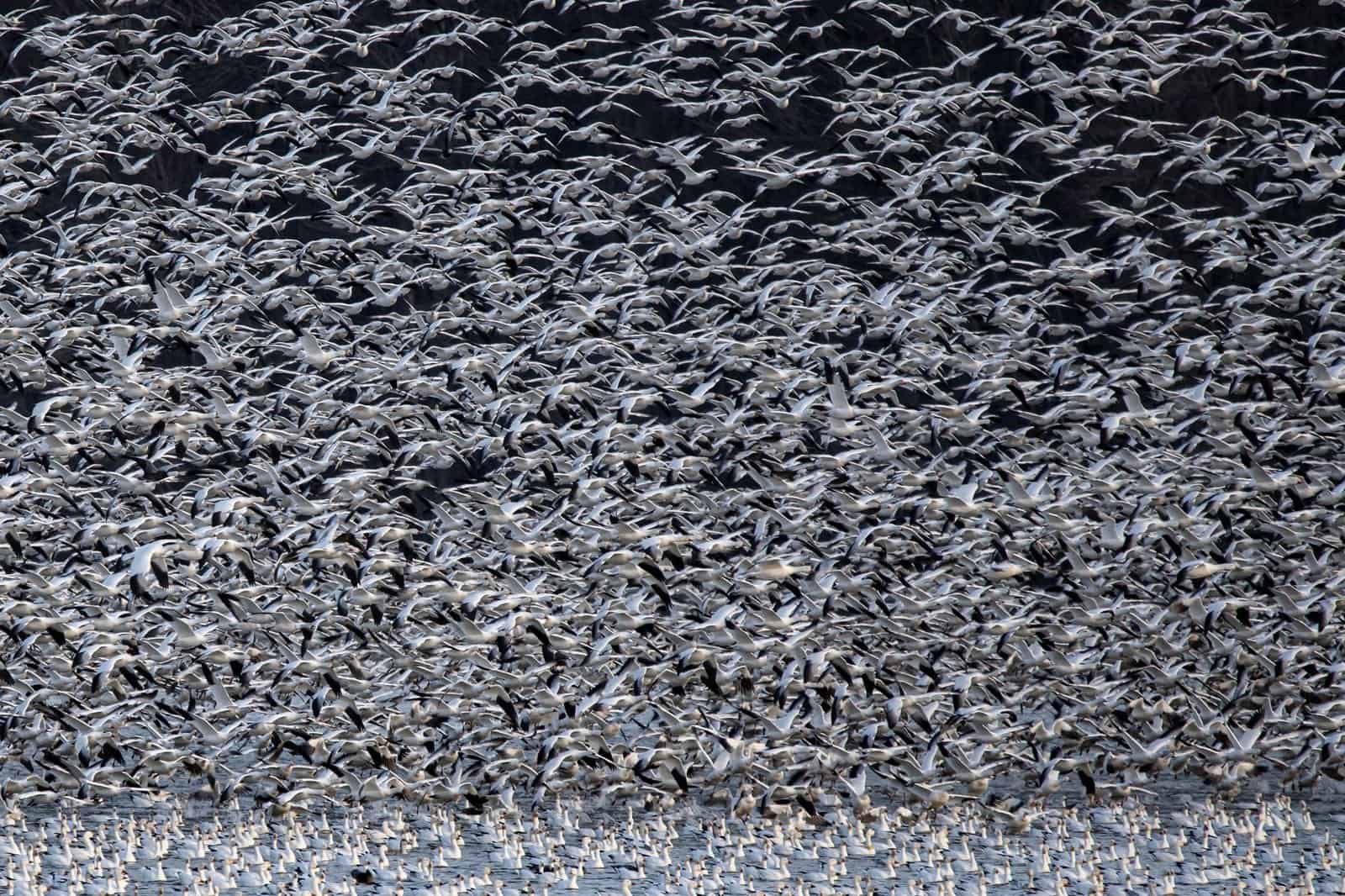
Snow geese are loud. A large flock makes a constant, high-pitched chatter you can hear long before you see it. When something spooks them, like a hawk, an eagle, or a passing truck, the whole flock lifts at once in a roar of wings. That liftoff is the moment people come for. The sky fills with white bodies and black wingtips, then the birds wheel and settle again.
Most of the geese you see will be white adults. Juveniles are grayer, and you will occasionally spot the darker “blue” form of the snow goose mixed in. Look for trumpeter and tundra swans as well. Skagit County is one of the most important wintering areas for trumpeter swans in the Lower 48, and the swans often feed in fields near the geese. Bald eagles, northern harriers, and peregrine falcons patrol the same farms.
When to Go in the Skagit Valley
Snow geese generally settle in by November, and numbers stay high through winter. Here is how to time your visit:
- November through January is a good window for big, settled flocks.
- Mornings are usually best, when birds fly in from the bays to feed.
- Late afternoon can bring flights back toward roosting areas.
- Weekdays mean less traffic on farm roads.
- Rain is common in Western Washington winters, but light rain rarely stops the geese.
Be aware that waterfowl hunting season runs through much of the same period, and some wildlife area units are open to hunting. Wear bright colors if you walk dikes, read posted signs, and expect to hear gunshots on some days.
Rules for Viewing on Farm Roads
Most of the valley is private, working farmland. The flocks are on someone’s fields, and farmers are on these roads with tractors and trucks.
- Pull completely off the pavement and never block field entrances or driveways.
- Stay in or next to your car rather than walking into fields.
- Do not deliberately flush the geese for photos. Every flight costs them energy they need for winter.
- Use binoculars and a spotting scope rather than trying to get closer.
- Parking at state wildlife areas generally requires a Washington state recreation access pass, so check requirements before you go.
Your car makes a fine bird blind. Geese tend to tolerate a stopped vehicle better than a person on foot.
Other Birds Sharing the Fields
The geese get the headlines, but the valley’s winter bird list is long. Trumpeter swans, the largest waterfowl in North America, feed in fields of leftover potatoes and corn, often in family groups with gray young. Tundra swans mix in, slightly smaller and with a different voice. Northern pintails, American wigeon, and mallards crowd flooded fields and sloughs.
Raptors follow the food. Bald eagles sit in cottonwoods along the river and dikes. Northern harriers glide low over the fields, red-tailed and rough-legged hawks perch on fence posts, and short-eared owls hunt the Samish Flats at dusk in some winters. A good day can easily produce several dozen species without leaving the farm roads.
How to Get There From Seattle
The Skagit Valley lies about an hour north of Seattle on Interstate 5, depending on traffic. Take the Conway exit for Fir Island and Wylie Slough, or exits near Mount Vernon and Burlington for the flats and the Samish area.
La Conner, a historic waterfront town on the Swinomish Channel, makes a natural base. It has restaurants, galleries, and small inns, and it sits at the edge of the flats. Mount Vernon and Burlington have more hotel options and chain restaurants.
Making a Day of It
A simple day plan:
- Morning: Fir Island Farm Reserve, then Wylie Slough’s boardwalk.
- Late morning: slow loop through the Fir Island farm roads.
- Lunch: La Conner, with a walk along the waterfront.
- Afternoon: drive north to the Samish Flats for raptors, or west toward Padilla Bay’s estuary reserve and its interpretive center.
- Late day: watch for flights back toward the bay.
Bring warm, waterproof layers, binoculars, a field guide or app, and snacks. Cafes are few between towns.
The Long Trip From Wrangel Island
Many of the snow geese wintering in the Skagit and nearby Fraser River delta in British Columbia nest on Wrangel Island, a remote Arctic island in the Chukchi Sea, off the coast of Russia’s far northeast. They breed there during the brief Arctic summer, raise their young, and then fly thousands of miles south in the fall, stopping along the way to rest and refuel.
That means the geese you watch in a muddy Skagit field in December may have been on Arctic tundra in August. Biologists track the population closely, and its size has shifted over the decades with breeding success and conditions along the route. Some years bring more birds to the Skagit, others shift more of the flock to the Fraser delta or Port Susan.
Photographing the Flocks
The classic image is a sky full of white geese with Mount Baker or the Cascades behind them. Here is how to improve your odds.
- Use a fast shutter speed, at least 1/1000 second, to freeze wings in flight.
- On gray days, raise your ISO rather than letting shutter speed drop.
- Expose for the white birds so they do not blow out to blank shapes.
- Wait. Flocks lift on their own when an eagle or harrier passes over, and patience produces better shots than flushing them.
- Shoot from your car window with a beanbag to steady a long lens.
Why the Skagit Valley Snow Geese Come Here
The Skagit River delta has the right ingredients for a wintering goose. Broad tide flats and estuaries provide safe places to roost at night. Rich farm fields nearby provide leftover crops and green shoots for daytime feeding. Winters are mild, rarely freezing hard enough to lock up food. And farmers, conservation groups, and the state have worked to keep some land in habitat as the region grows.
The geese have been coming for a long time. Watching them is free, accessible from the car, and one of the most dramatic ways to spend a gray Northwest winter morning. Get there early, find the white on the horizon, and wait for the flock to lift.