Pacific Grove, California Will Fine You $1,000 for Bothering a Butterfly. Here’s How to See the Monarchs Right
We may earn money or products from the companies mentioned in this post. This means if you click on the link and purchase the item, I will receive a small commission at no extra cost to you ... you're just helping re-supply our family's travel fund.
Pacific Grove has a city ordinance, on the books since 1952, that makes it unlawful to molest or interfere with monarch butterflies during their annual visit. The police department enforces it with a fine of up to $1,000. That is not a joke on a souvenir mug. It is the city’s way of protecting Pacific Grove monarch butterflies at one of the most important wintering sites in California.
If you want to see the Pacific Grove monarch butterflies the right way, the short answer is to go to the Monarch Grove Sanctuary on a sunny day between November and February, arrive around midday, look up rather than around, stay on the paths, and keep your hands and pets to yourself. The rest of this article explains what you will see and how to time it.
The town calls itself “Butterfly Town, USA” and holds a butterfly parade every October. The fine and the parade come from the same place: residents who have spent decades trying to keep a fragile migration intact.
Here’s How to See the Monarchs Right
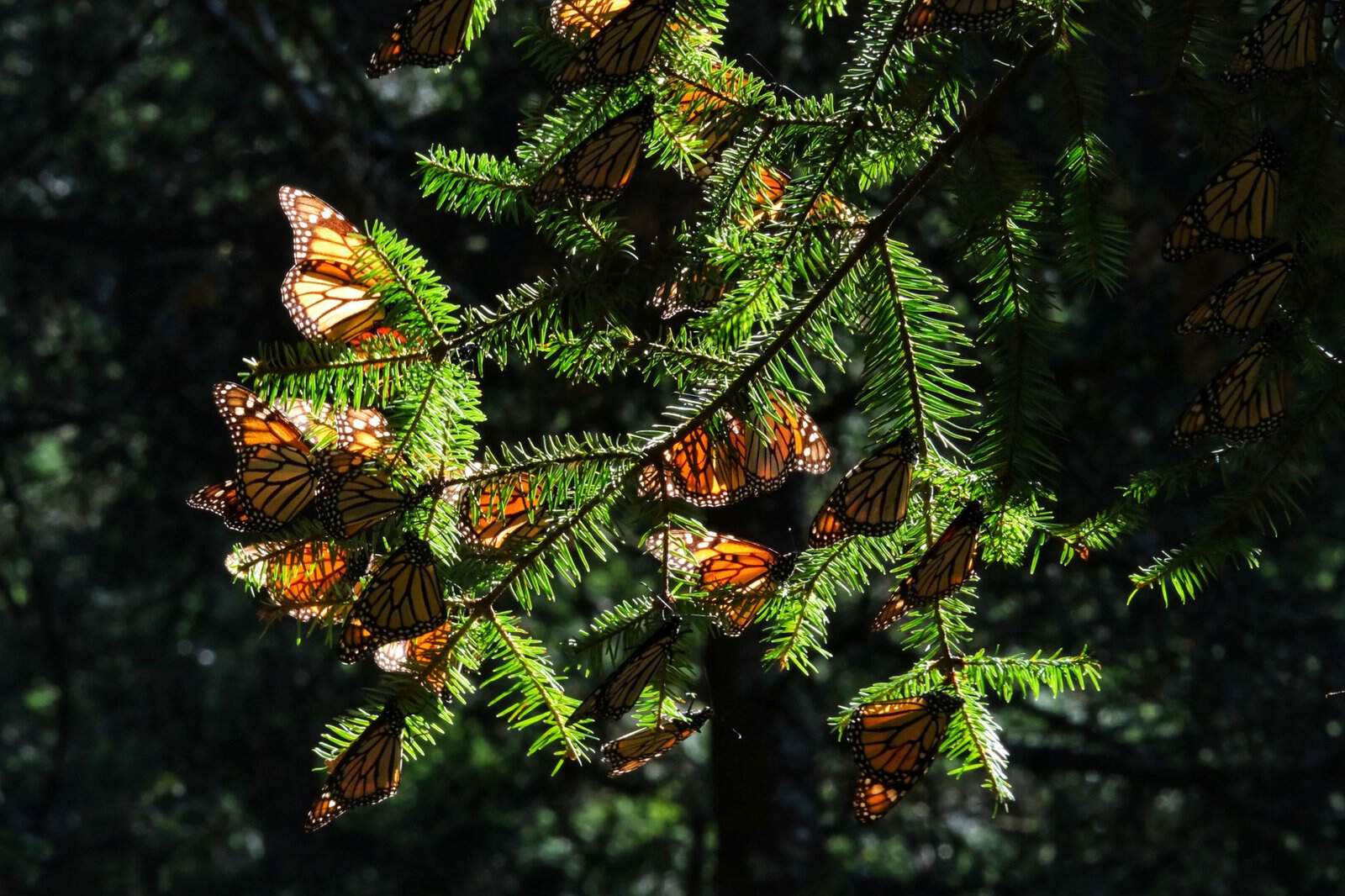
Western monarchs do not fly to Mexico like eastern monarchs. Most of the western population spends winter along the California coast, in groves of eucalyptus, Monterey pine, and cypress that provide shelter from wind and frost. Pacific Grove’s Monarch Grove Sanctuary is one of the best-known of those sites.
Here is the routine that gives you the best chance of a good viewing:
- Go between roughly November and February, when clusters are most stable. Butterflies start arriving in October and leave by around March.
- Pick a sunny day. On cold or foggy mornings, monarchs stay packed in tight clusters and look like clumps of dead leaves.
- Arrive late morning to early afternoon. As temperatures pass about 55 degrees, butterflies warm up, open their wings, and flutter.
- Look up. Clusters hang from branches high in the trees, sometimes 30 to 60 feet overhead.
- Bring binoculars. They make the difference between “is that a branch” and seeing individual wings.
- Find a docent. Volunteers often set up spotting scopes and know where the clusters are that week.
What the Rules Say About Pacific Grove Monarch Butterflies
The 1952 ordinance makes it unlawful to “molest or interfere with, in any way” the monarchs while they stay within city limits. The sanctuary and the Pacific Grove Museum of Natural History list practical rules that put that into everyday terms:
- Stay on designated paths.
- Do not bring dogs or other pets into the sanctuary.
- Do not touch, pick up, chase, or stress the butterflies.
- Keep voices down.
- No food or smoking inside the sanctuary.
Touching a monarch can rub scales off its wings and damage its ability to fly. Shaking a branch to “wake them up” can knock clusters to the ground on a cold day, where butterflies can freeze or be stepped on. The rules sound strict, but each one protects a creature that weighs about half a gram.
How Many Butterflies You Can Expect
Be ready for a wide range. Western monarch numbers have swung dramatically over the past few decades. Counts at overwintering sites across California dropped to alarming lows around 2018 to 2020, then rebounded in some later years. Pacific Grove has seen seasons with a few hundred butterflies and seasons with many thousands.
The Xerces Society runs an annual Western Monarch Count around Thanksgiving, with volunteers tallying butterflies at sites up and down the coast. The results are posted each winter and give you a sense of the season’s strength. If the count is low, you may see small clusters rather than the dense curtains in old photos. It is still worth going, especially with a docent who can point out what you are looking at.
What a Monarch’s Winter Looks Like
Western monarchs that reach Pacific Grove in the fall are not the same butterflies that left the coast the previous spring. Monarchs that hatch in summer live only a few weeks. The generation that migrates in the fall is different: it can live for several months, long enough to fly to the coast, wait out winter, and start the trip inland in early spring.
Clustering is how they survive. By packing together on branches, butterflies reduce exposure to wind and hold a little more warmth. On a cold morning, a cluster looks like brown, papery leaves. As sunlight hits it and the air warms, the outer butterflies start to open their wings and show orange, and then a few take off to bask, drink, or find nectar. On a warm afternoon you may see hundreds drifting through the grove at once.
By February, mating behavior begins. You may notice pairs on the ground or in the air, and that is the signal the season is ending. By March, most butterflies have left to lay eggs on milkweed farther inland, and the cycle starts again.
Planning Around the Rest of the Monterey Peninsula
A monarch visit takes an hour or two, so build a day around it. Pacific Grove’s shoreline along Ocean View Boulevard is one of the most scenic walks on the peninsula, with tide pools, harbor seals, and winter swells crashing on granite. Lovers Point Park is a good place for coffee and a view.
- Point Pinos Lighthouse, at the tip of the peninsula, is often described as the oldest continuously operating lighthouse on the West Coast.
- Asilomar State Beach has dunes and boardwalks a short drive from the sanctuary.
- The 17-Mile Drive starts nearby, though it charges a per-vehicle fee.
- Cannery Row and the Monterey Bay Aquarium are a few minutes away.
Winter on the peninsula is cool, with highs often in the high 50s to low 60s, and rain comes in storms rather than steady drizzle. Pick a clear day in the forecast for the sanctuary and save the aquarium for a gray one.
Getting to the Monarch Grove Sanctuary
The sanctuary is a small grove in a residential neighborhood on Ridge Road, near Lighthouse Avenue, a few minutes from downtown Pacific Grove. Entry is free. Street parking is limited, so expect to walk a block or two and be respectful of residents’ driveways.
Pacific Grove sits on the tip of the Monterey Peninsula, next door to Monterey and a short drive from Carmel. It is about 70 miles south of San Jose and roughly two to three hours from San Francisco depending on traffic.
- From Monterey, it is about a 10-minute drive.
- The Monterey Bay Aquarium is about two miles away, making it easy to combine the two.
- Lodging in Pacific Grove ranges from historic Victorian inns to motels, with winter rates often lower than summer.
Mistakes Visitors Make at the Sanctuary
Most disappointing visits come down to a few avoidable errors.
- Arriving at 8 a.m. on a foggy day and leaving before the butterflies wake up. Give it until midday.
- Looking at eye level. The clusters are overhead, often high in the eucalyptus.
- Skipping the docents. Volunteers often know exactly which branch holds the biggest cluster that week.
- Bringing a dog. Pets are not allowed in the sanctuary, and leaving one in a car is not fair to the dog.
- Assuming a low count means no butterflies. Even small clusters are worth a look through binoculars.
The fix for nearly all of them is patience. Sit on a bench, wait for sun to break through, and watch the grove change.
Other Places to See Wintering Monarchs Nearby
If you are on the Central Coast for more than a day, add a second site. Natural Bridges State Beach in Santa Cruz has a monarch grove with a boardwalk trail and seasonal ranger programs. The Pismo Beach Monarch Butterfly Grove, farther south near the Pismo State Beach campground, is another major site with docents in season.
Each grove has its own microclimate, so a cool, gray morning at one may be sunny and active at another. Comparing them also shows you how much each site depends on a small patch of trees.
Why Pacific Grove Takes This So Seriously
The groves that monarchs choose are not random. Butterflies need trees that block wind, a mix of sun and shade, nearby water, and nectar sources for warm days. Lose the trees and the butterflies have nowhere to go. Pacific Grove voters approved a special tax decades ago to buy and protect the sanctuary land, and volunteers maintain it.
The town also celebrates the monarchs every October with a parade led by children in butterfly costumes, a tradition that has run for generations. The Pacific Grove Museum of Natural History, a few blocks from downtown, has exhibits on the migration and the life cycle, and it is a good stop on a cloudy day when the butterflies are not moving.
The $1,000 fine gets attention, but the reason behind it is simple. A tiny insect that flies hundreds of miles to winter in one grove deserves a little space. Go on a warm, bright day, look up, stay quiet, and let the butterflies come to life on their own schedule.