North Dakota’s Enchanted Highway Has 7 Giant Scrap-Metal Sculptures in 32 Miles. Here’s Each One, in Order
We may earn money or products from the companies mentioned in this post. This means if you click on the link and purchase the item, I will receive a small commission at no extra cost to you ... you're just helping re-supply our family's travel fund.
The Enchanted Highway North Dakota route is 32 paved miles of farm country in the southwest corner of the state, with seven of the largest scrap-metal sculptures in the world standing beside the road. It runs south from Interstate 94 at Exit 72, near Gladstone, to the town of Regent. The sculptures are free, open all the time, and visible from a long way off.
A retired schoolteacher named Gary Greff started building them in 1989 because he was watching his hometown of Regent empty out. He had no art training and had never welded. His plan was to build something big enough that people would drive out of their way to see it. More than three decades later, the road draws visitors from around the world to a town of fewer than 200 people.
Here’s every sculpture, in the order you’ll reach them heading south, with approximate mile markers from the interstate exit.
All 7 Enchanted Highway Sculptures, in Order
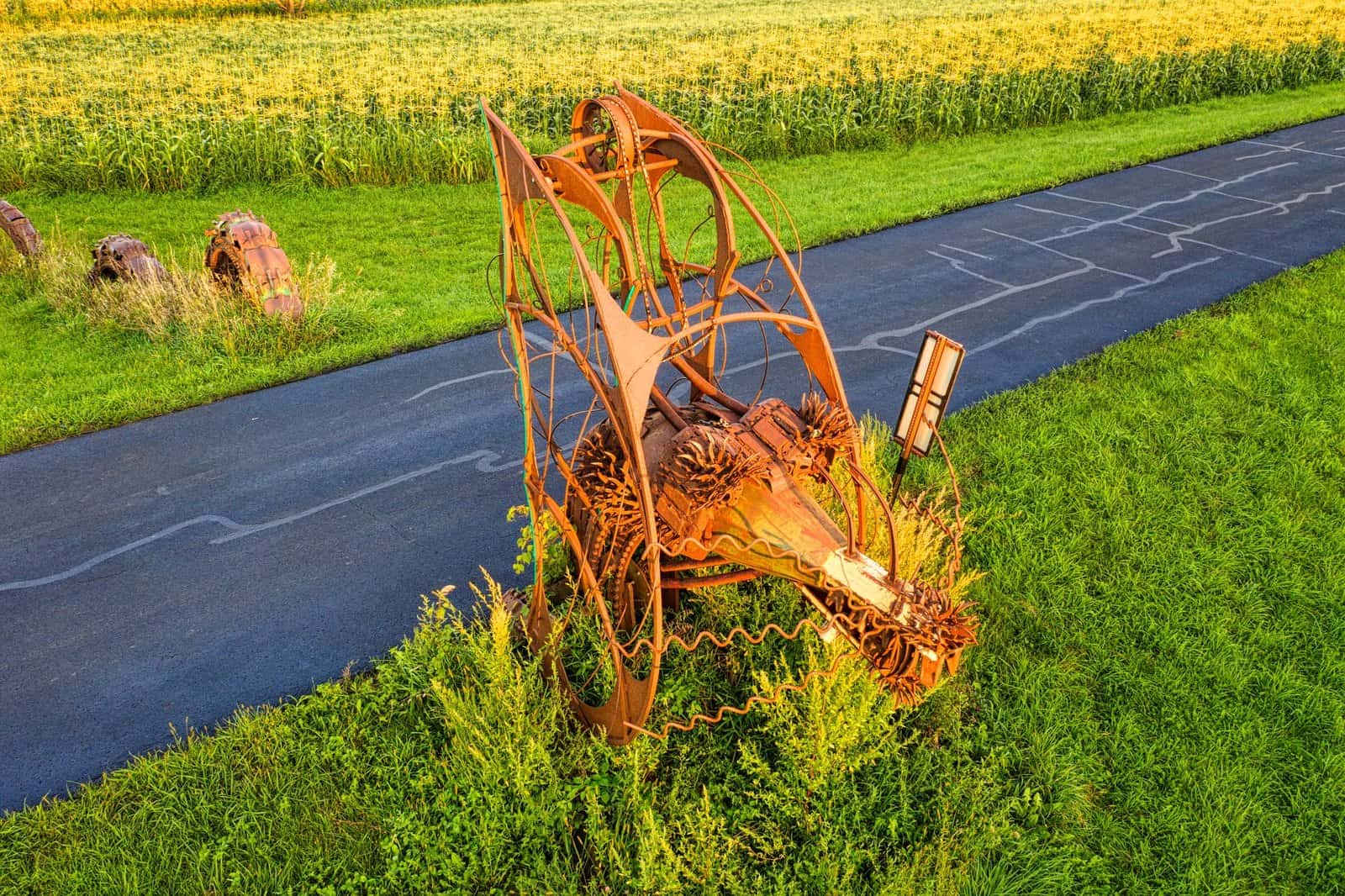
Every sculpture except the first has a developed pull-out with parking, and several have picnic shelters and information kiosks. The road is County Highway 21, a rural two-lane. Pull fully off the road before you get out, and don’t stop in the lane for photos.
1. Geese in Flight (Mile 0, I-94 Exit 72)
Geese in Flight stands right beside Interstate 94 at the Gladstone exit, so you see the biggest sculpture before the drive even starts. It’s about 110 feet tall and 154 feet wide and weighs about 158,000 pounds. Since 2002, Guinness World Records has recognized it as the world’s largest scrap-metal sculpture.
Greff installed it in 2001 as a kind of artistic billboard to pull travelers off the interstate. The flock of geese is cut from oil well tanks and pipe, and it’s set against a backdrop that frames the birds against the sky. It’s viewable from the area near the exit rather than from a dedicated highway pull-out.
2. Deer Crossing (Mile 3)
About three miles south, Deer Crossing shows a leaping buck about 75 feet tall and a doe about 50 feet tall, mid-bound over a fence. It went up in September 2002 and took two cranes to lift into place.
It’s the sculpture that best shows off Greff’s sense of motion. From the right angle, the buck looks like it’s clearing the fence over the road.
3. Grasshoppers in the Field (Mile 15)
The longest gap on the route comes next, about 12 miles to Grasshoppers in the Field, completed in 1999. It features giant grasshoppers among oversized metal wheat stalks, a nod to the insects every farmer in the region knows too well.
This stop has a picnic area and is a good place to stretch your legs. The open farmland around it gives you a sense of how far you are from anywhere.
4. Fisherman’s Dream (Mile 19)
Fisherman’s Dream, finished in 2006, is a scene of huge metal fish leaping from a lake, with a fisherman in a boat who has hooked one. North Dakota’s lakes and reservoirs are full of walleye and northern pike, and the sculpture celebrates the state’s fishing culture.
It’s one of the more detailed pieces on the route, with individual fish in different poses. Walk around it for the full effect.
5. Pheasants on the Prairie (Mile 24)
Pheasants on the Prairie, completed in 1996, shows a family of ring-necked pheasants. The rooster stands about 40 feet tall, with a hen and chicks beside it. Pheasant hunting is a major fall tradition in the Dakotas, and southwest North Dakota draws hunters every season.
This one is especially photogenic in late afternoon, when the low sun lights up the birds’ metal feathers.
6. Teddy Rides Again (Mile 26)
Teddy Rides Again, built in 1993, shows Theodore Roosevelt on horseback. Roosevelt ranched in the North Dakota badlands in the 1880s and later credited the experience with shaping him, and the national park named for him is about an hour and a half west.
It’s a tribute to the most famous outsider who fell for western North Dakota, rendered in welded steel and set against the prairie he wrote about.
7. The Tin Family (Mile 30)
The Tin Family, completed in 1991, was the first sculpture Greff built and is the last one you reach. It shows a farm father, mother, and child built from old farm tanks and metal, a tribute to the families who homesteaded the region. It’s often called the World’s Largest Tin Family.
From here, Regent is two miles south. The Enchanted Castle Gift Shop in town sells postcards and souvenirs that help fund maintenance of the sculptures.
The Town at the End of the Road
Regent is the reason the Enchanted Highway exists. Greff bought an empty school in town and later turned a building into the Enchanted Castle hotel, styled like a medieval castle, with a steakhouse. Visitors may find him working in the gift shop or the restaurant.
He has kept building, too. A new piece featuring a knight and a dragon has been in progress near the hotel, and Greff has said he never trusts his own estimates of when a sculpture will be finished. Regent also has a small pioneer museum.
How Long the Enchanted Highway North Dakota Drive Takes
The full route is 32 miles, and the sculptures themselves are free and unstaffed. Plan on:
- About 45 minutes of driving one way with no stops.
- One and a half to two hours if you stop at every sculpture and take photos.
- Three to four hours as a round trip with lunch in Regent.
If you’re coming from Theodore Roosevelt National Park and Medora, it’s about 45 miles east on I-94 to Exit 72. Many travelers combine the two in one day.
Driving Tips for the Enchanted Highway
A few practical points:
- Fill your gas tank before you turn south. There are no services between Gladstone and Regent.
- Bring water and snacks, especially in summer.
- Watch for farm equipment and wildlife. Deer are common at dawn and dusk.
- In winter, check road conditions. The road is paved, but snow, ice, and wind can make it hazardous, and help can be far away.
- Cell service can be patchy, so download a map before you go.
When to Go
The sculptures are open year-round, and each season changes the scene. Summer brings green fields and long daylight. Fall, from September into November, has golden stubble fields and pheasant season, with hunters on the back roads. Winter turns the sculptures into silhouettes against snow, but daylight is short and travel is riskier.
Late afternoon in any season gives the best light, with long shadows across the prairie and warm color on the metal.
Who Gary Greff Is
Greff grew up in Regent and left for years, working as a teacher and school principal before returning home. He came back to a town that was shrinking, with young people leaving and businesses closing, a pattern repeated across rural North Dakota for most of the past century.
He decided that a town too far from the interstate to get passing traffic needed a reason for people to make the trip. He taught himself to weld, recruited help from local farmers and welders, and began using what the region had in abundance: scrap metal from oil-field tanks, pipe, and old farm equipment. He has said in interviews that he’d never laid a bead of weld before starting the project.
The work has been mostly self-funded and supported by donations, gift shop sales, and visitors. Each sculpture took years to build, and maintenance is constant, since prairie wind, hail, and winter cold are hard on steel.
Combining It With Theodore Roosevelt National Park
The Enchanted Highway fits neatly into a trip to western North Dakota’s most famous attraction. Theodore Roosevelt National Park’s South Unit sits at Medora, about 45 miles west of Exit 72 on I-94. Roosevelt himself later said he would never have been president if not for his experiences in North Dakota, which makes the Teddy sculpture on the highway a fitting connection.
A simple one-day plan:
- Morning: Drive the scenic roads in the national park’s South Unit and look for bison and wild horses.
- Midday: Eat lunch in Medora, then drive east on I-94.
- Afternoon: Stop at Geese in Flight at Exit 72 and drive the Enchanted Highway south to Regent.
- Evening: Eat dinner and stay at the Enchanted Castle in Regent, or drive back to the interstate and continue on to Dickinson or Bismarck.
Why This Road Matters
Small towns across the Great Plains have been losing population for decades, and Regent is no exception. What makes the Enchanted Highway unusual is that one person decided to fight that with sheer scale, using scrap metal from the region’s oil fields and farms. The sculptures are tourism, folk art, and a stubborn civic gesture all at once.
Drive it slowly, stop at every pull-out, and spend some money in Regent when you get there. That’s the whole point.