Mark Twain Left Hannibal at 17 and Rarely Returned. So Why Does This Missouri Town Still Center Its Identity on Him?
We may earn money or products from the companies mentioned in this post. This means if you click on the link and purchase the item, I will receive a small commission at no extra cost to you ... you're just helping re-supply our family's travel fund.
Mark Twain, born Samuel Clemens, lived in Hannibal, Missouri from age four until he left at seventeen to become a printer’s apprentice, and he never lived there again for any extended period as an adult afterward. Yet Hannibal’s entire tourism economy, and much of its civic identity today, runs on those thirteen childhood years, which Twain later fictionalized into St. Petersburg, the setting of both The Adventures of Tom Sawyer and Adventures of Huckleberry Finn, two of the most widely read novels in American literary history.
The town’s population has hovered around 17,000 for decades, declining slightly from its mid-twentieth-century peak, and Twain-related tourism remains one of the few consistent economic engines keeping the historic downtown along the Mississippi River genuinely viable rather than following the path of decline seen in many comparable small river towns nearby.
What Literary Tourism Actually Funds
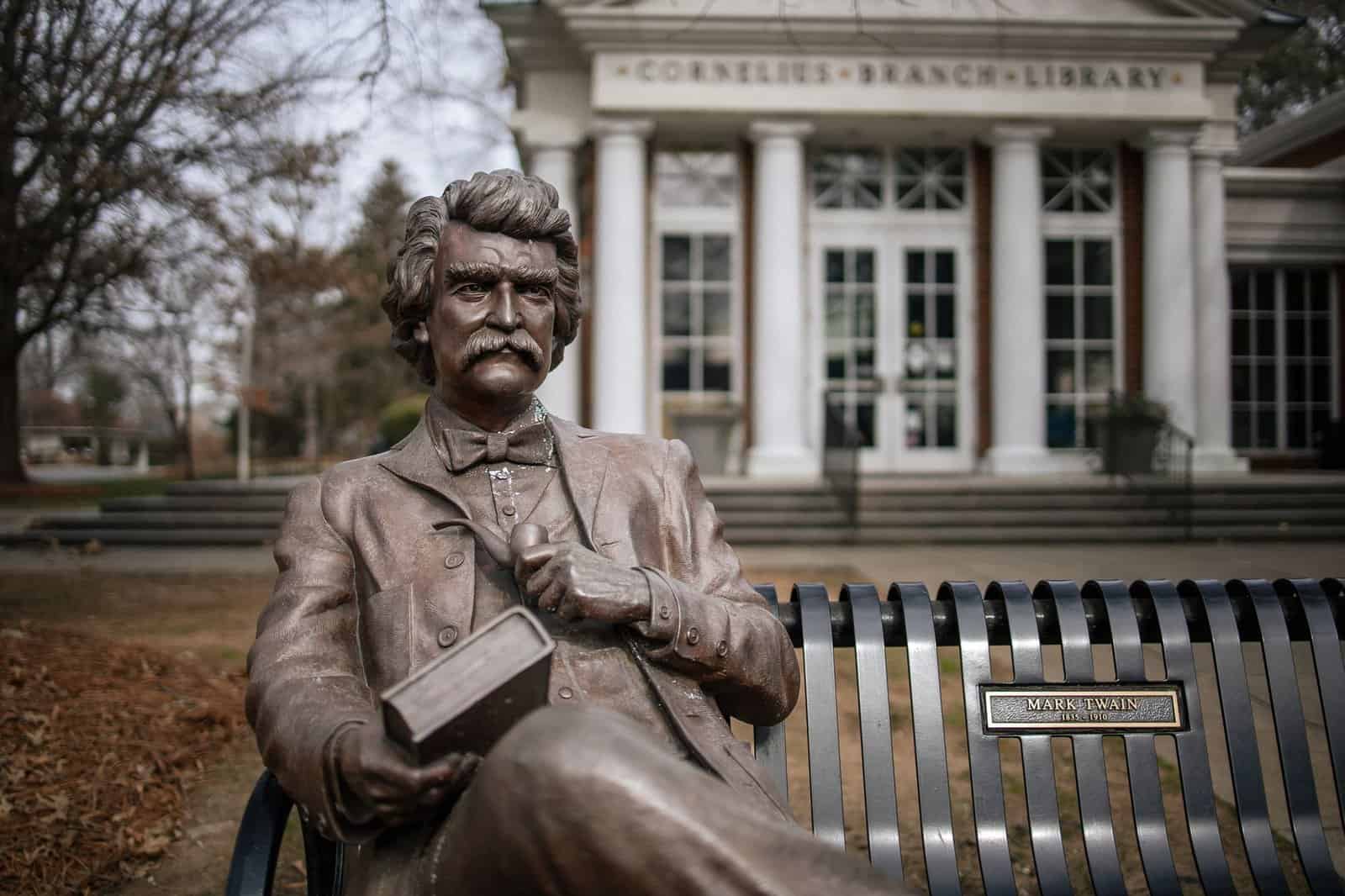
The Mark Twain Boyhood Home and Museum, centered on the actual white clapboard house where Twain lived as a child, anchors a multi-building museum complex that draws visitors from across the country and internationally, with Hannibal’s tourism office long citing Twain-related sites as the primary draw for the large majority of overnight visitors to the town each year. The museum complex includes the Becky Thatcher House, modeled on Twain’s childhood friend and the inspiration for the character, and a walkable historic district along Main Street lined with buildings dating back to the mid-1800s.
The economic reality is that Twain tourism supports a specific and fairly narrow set of businesses: the museum complex itself, several gift shops selling Twain and Tom Sawyer merchandise, a handful of restaurants positioned for tour bus traffic, and riverboat cruise operators running short excursions on the Mississippi River. It does not, by itself, support a fully diversified economy, and Hannibal outside the historic core looks like many other small Missouri river towns that have lost population and manufacturing jobs over the past several decades.
The Real Twain Sites Versus the Fictionalized Version
Part of what makes Hannibal’s tourism unusual is the blending of biography and fiction throughout the town’s attractions. Twain’s actual childhood home coexists with statues and sites explicitly built around fictional Tom Sawyer and Huckleberry Finn scenes, including a Tom and Huck statue at the base of Cardiff Hill referencing the famous whitewashing-the-fence scene, and an annual Tom Sawyer Days festival each Fourth of July weekend featuring a fence-painting contest and a frog-jumping competition that directly references Twain’s short story ‘The Celebrated Jumping Frog of Calaveras County.’
Twain himself had a complicated relationship with Hannibal as an adult, writing about it with deep nostalgia in works like Life on the Mississippi while also being clear-eyed about the town’s provincialism and the realities of slavery he witnessed there firsthand as a child. Hannibal was a Mississippi River port town where enslaved people were bought and sold, a history the museum complex has worked in recent years to represent more directly than it did for most of the twentieth century.
What Else Is Actually in Hannibal
Mark Twain Cave, a genuine cave system Twain explored as a child and later featured prominently in Tom Sawyer, still offers guided tours today and remains one of the town’s most consistently popular attractions outside the core museum complex. Riverview Park overlooks the Mississippi River and the town below from a bluff-top setting, while Rockcliffe Mansion, a 1900 Gilded Age mansion unrelated to Twain but open for tours, reflects the town’s brief and largely forgotten lumber-boom wealth from the turn of the twentieth century.
Hannibal’s riverfront, rebuilt and reinforced after repeated flooding throughout the twentieth century, now includes a floodwall that doubles as a public art installation, painted with murals depicting scenes from Twain’s writing, a practical infrastructure project that the town turned into another small tourist attraction in its own right.
- Mark Twain Boyhood Home and Museum: the core complex, includes several connected historic buildings
- Mark Twain Cave: a cave system Twain explored as a child, later featured in Tom Sawyer
- Riverview Park: overlooks the Mississippi River and the town below
- Rockcliffe Mansion: a 1900 Gilded Age mansion unrelated to Twain but open for tours
What Keeps Longtime Residents Invested in the Twain Identity
Local business owners and city officials describe a pragmatic relationship with the town’s literary branding: it is, quite simply, the only globally recognizable asset Hannibal has to build an economy around, and few residents seriously argue for de-emphasizing it even as some push for a more honest accounting of the era Twain actually depicted. School groups remain a significant part of the museum’s annual visitor base, arriving on field trips tied directly to required reading of Twain’s novels in classrooms across the Midwest.
The town’s median household income and overall economic indicators lag well behind Missouri state averages, a reminder that literary tourism, however successful within its narrow lane, has not been enough on its own to reverse the broader economic patterns affecting small river towns across the region.
Local preservationists continue restoring additional buildings in the historic district beyond the core Twain sites, betting that a deeper, more textured downtown will extend the average length of a visit beyond the half-day most tourists currently spend before continuing on toward St. Louis or Chicago, a strategy several other small river towns along the Mississippi have watched Hannibal pursue with real interest of their own.
The Riverboat and Riverfront Economy Beyond the Museums
Hannibal’s Mississippi riverfront still supports a working excursion boat operation offering short sightseeing cruises that trade heavily on the same Twain-era steamboat imagery driving the rest of the town’s tourism identity, giving visitors a way to experience the river itself rather than only reading about Twain’s descriptions of it in a museum setting.
Annual events built around the Twain identity, including a National Tom Sawyer Days festival held each July featuring a fence-painting contest referencing the novel’s most famous scene, draw visitors from well beyond Missouri’s borders and represent some of the only weekends each year when Hannibal’s hotels and restaurants approach full capacity.