What Families With Teenagers Discover About Travel That Nobody Warns Them About
We may earn money or products from the companies mentioned in this post. This means if you click on the link and purchase the item, I will receive a small commission at no extra cost to you ... you're just helping re-supply our family's travel fund.
This article contains affiliate links. If you book travel through our links, we may earn a commission at no extra cost to you.
Every parent who survived travel with a toddler has a moment where they think: at least when they’re older, it’ll be easier. The logistics of flying with small children — the car seats, the stroller gate-checks, the snacks and the meltdowns and the entire duffel bag of entertainment — make travel feel like a military operation. Surely teenagers, who can carry their own luggage and use the bathroom independently, are an improvement.
Some things do get easier. But the ways travel gets harder with teenagers are almost completely unexpected, and nobody warns you about them in advance.
The Moment the Family Trip Changes Forever
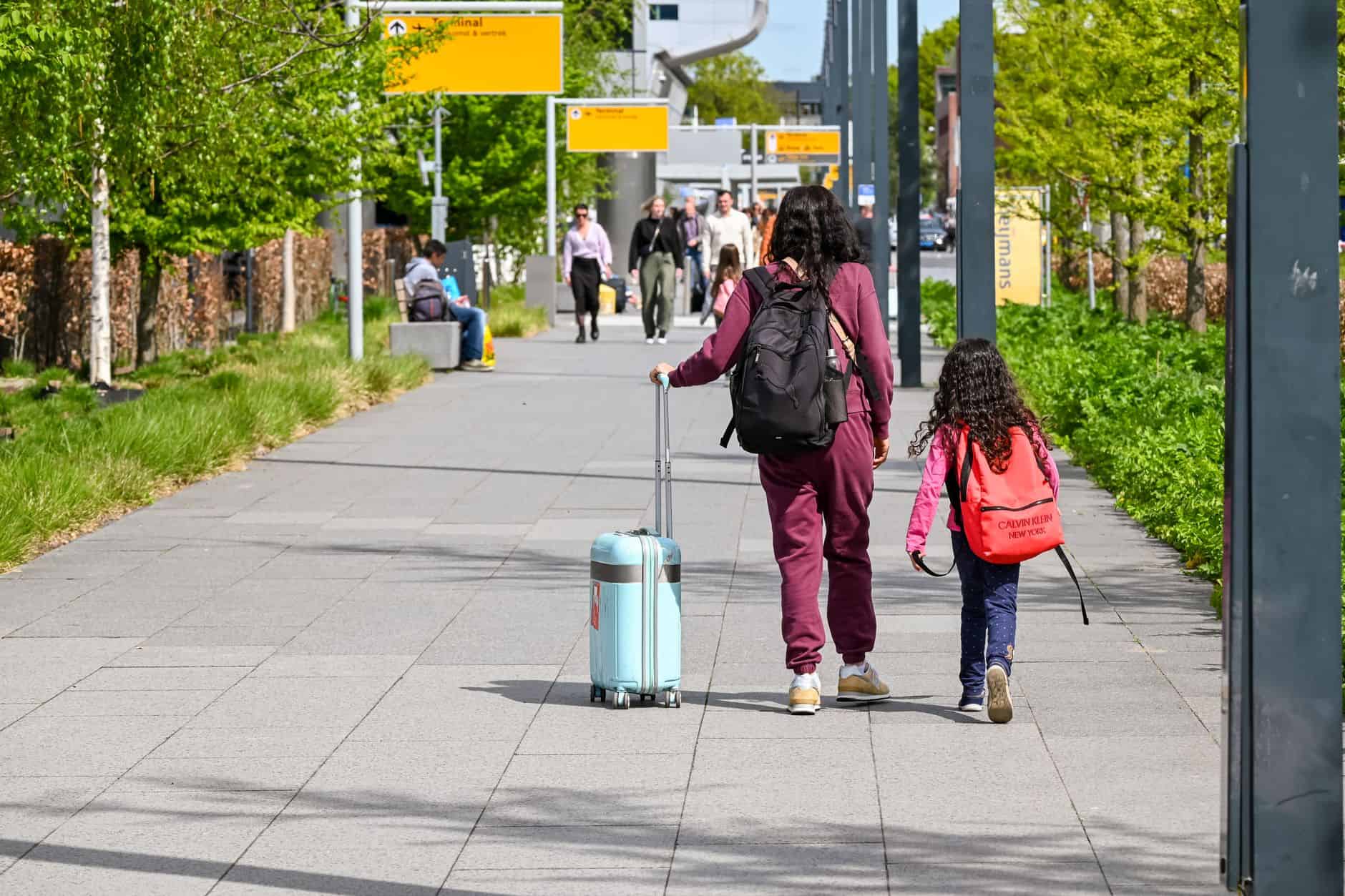
Most parents can identify the exact trip where it shifted. It’s not a gradual change. There is a specific vacation — often around the time the oldest child hits 13 or 14 — where the family trip suddenly stops feeling like a family trip and starts feeling like a hostage negotiation with better scenery.
The child who used to run toward dolphins now wants to sleep until noon. The one who cried with joy at Disneyland is now doing a detailed cost-benefit analysis of whether the park lines are worth it. The person who used to think your dad jokes were funny is now acutely embarrassed to be seen in public walking next to you.
This is developmentally completely normal. Adolescence is defined by individuation — the psychological process of separating from parents and forming an independent identity. Travel, which is an inherently family-bonding activity, runs directly against that developmental current. You have engineered a situation where your teenager cannot escape you for a week. And then you are surprised when they seem to want to escape you.
The Itinerary Negotiation Nobody Prepares You For

With young children, parents make the plans and children comply, more or less. With teenagers, the planning process becomes genuinely complex, and families who don’t account for this end up in miserable standoffs in hotel lobbies in foreign countries.
The teenager doesn’t want to do what you planned. But they don’t have an alternative plan. And they don’t have the self-awareness yet to articulate what they actually want, which is usually some combination of autonomy, peer contact, digital access, and food that isn’t the local cuisine their parents are enthusiastically forcing on them.
Families who navigate this well almost universally report doing one thing: giving teenagers genuine input before the trip, not performative input. Not “here’s the itinerary, any thoughts?” but “what is one thing you actually want to do on this trip, and we will build a day around it?” The specificity matters. “What do you want to do” gets a shrug. “You have four hours in this city — what would make this trip worth it for you?” gets an actual answer.
The answers are often surprising. The teenager who has seemed profoundly uninterested in the trip turns out to want to find a specific record store in Tokyo, or see a specific soccer stadium in Barcelona, or eat at a specific chain restaurant that isn’t available at home. These are not profound cultural experiences. They are, however, the teenager’s own. And the degree to which a trip contains something that is theirs — not their parents’ aspiration, but theirs — determines almost everything about whether they’ll be present for the rest of it.
What Teenagers Actually Remember From Trips

This is the part that humbles every parent who has invested significant money in educational family travel. Researchers who study autobiographical memory have found that what people remember from adolescent family vacations is almost never the thing their parents were most proud of.
The Louvre, the Colosseum, the sunrise at Angkor Wat — these are the parental highlight reel. What teenagers remember, with specificity and emotion, decades later, is almost always something incidental. The card game played in a cramped hotel room during a rainstorm. The restaurant where the order went completely wrong and everyone laughed. The afternoon where the plans fell through and the family ended up wandering without direction and somehow found something better. The moment of genuine parental vulnerability — getting lost, admitting they didn’t know something, laughing at themselves.
The memory research on this is consistent enough that some family travel consultants have started explicitly advising parents to stop trying so hard. The memories that stick are the unplanned ones, and the relentless pursuit of curated experiences can actually crowd out the space where those moments happen.
The Phone Problem Is Not What You Think

Every parent of a teenager traveling internationally has a version of the phone conflict. But families who’ve navigated it well are almost unanimous that the framing most parents use is wrong.
The instinct is to treat the phone as the enemy of the trip — the thing pulling the teenager out of the present experience and back into their online life. Some parents confiscate phones, limit data plans, or require phone-free mealtimes. These rules are met with the predictable response.
What the phone is actually doing, in most cases, is providing the teenager with peer contact — the thing they’ve been forced to give up for this trip. Adolescent social life is intensely present-tense. A week without contact with their friend group is a week of social anxiety and FOMO, not freedom. The phone is how they stay connected to the thing that matters most to them developmentally at this particular moment.
Families that do best with this tend to negotiate rather than prohibit. Two hours of phone time in the evening. Photos are allowed but posting is delayed. The teenager keeps the family’s location visible on Find My. These compromises feel unsatisfying to parents who wanted a device-free cultural immersion. They work.
Destinations That Actually Work — And Why

Not all destinations are equally well-suited to family travel with teenagers, and the mismatches are predictable once you understand what’s actually going on.
Destinations that parents love for their own reasons — slow-travel, beautiful landscapes, small villages, cultural immersion — are often exactly what teenagers find most miserable. No peers. No energy. Nothing to do after 8 p.m. The beauty that parents find restorative, teenagers experience as boredom.
Destinations that reliably work for families with teenagers share a few characteristics: they have genuine urban energy, they have some degree of youth culture the teenager can engage with, they have good food across a range of preferences, and they have moments of optional structure rather than mandatory itineraries. Tokyo comes up constantly in this context. So does London, for first international trips with American teenagers. Cities with distinct neighborhoods that can be explored semi-independently. Places where a teenager can be handed a subway map and told to meet you somewhere in two hours.
The partial independence is the key variable. Teenagers don’t want to be tourists. They want to briefly experience being locals. Any destination that allows for that — any trip structure that gives them moments of genuine unsupervised navigation — tends to generate dramatically better outcomes than trips where they’re managed every hour.
The Surprising Thing That Brings Them Back

Here is the thing parents most often report with surprise: years later, their teenagers-turned-adults frequently bring up the family trips as among the most important experiences of their lives. Not in the moment. Not even close to the moment. But later.
The developmental reason is that adolescence is a period of identity formation, and travel — even reluctant travel, even eye-rolling travel — exposes teenagers to ways of living that they file away and draw on later. The teenager who seemed completely checked out in Morocco at 15 turns out to have been quietly absorbing things that influenced how they think about the world at 25.
Parents who found this out, often from grown children who brought it up unprompted, almost universally describe the same emotional response: relief that they didn’t cancel the trips during the worst years, and a particular kind of retroactive forgiveness for how hard those vacations were in the moment.
When a Teen Refuses to Go

This happens more than parents admit, and it often creates genuine family fractures. The 16-year-old who has a summer job, a relationship, and a social calendar has a real competing claim on their time. The demand that they participate in a family trip can feel, from their perspective, like having a significant portion of their actual life canceled.
Family therapists who work with this issue are fairly consistent: forcing a teenager to go on a trip they’ve explicitly refused, over a genuine conflict rather than just resistance, tends to poison the trip and damage the relationship. The trip becomes a punishment rather than a gift, and it confirms the teenager’s narrative that their preferences and autonomy don’t matter.
The families that navigate this best tend to find ways to honor both things: the family trip happens, and the teenager’s real competing commitment is acknowledged as real. Sometimes that means a shorter trip. Sometimes it means the teenager joins for part of it. Sometimes it means genuinely letting them stay.
What Parents Get Wrong About ‘Making Memories’

The phrase “making memories” appears constantly in conversations about family travel, and it carries a specific parental anxiety: the fear that if they don’t create these experiences now, the window will close and the family will have missed something irreplaceable.
That anxiety is real and not entirely wrong. The window does close. But the mistake is in thinking that memories are manufactured by the right destination or the right itinerary. They’re not. They happen in the friction and the boredom and the unexpected moments, and they’re more likely to happen when families stop trying so hard to produce them.
The families who consistently describe the best travel memories with their teenagers are the ones who traveled regularly rather than grandly — not the one-time epic trip to a bucket-list destination, but the recurring trip to the same rental house, the same city, the same camping spot. Repetition creates depth. The teenager who has been to the same place four years in a row knows it differently than any first-timer, and that knowledge is its own kind of intimacy — with the place, and quietly, with the family that kept going back.