De-Icing Fluid Can Protect a Plane for Just Minutes. Here’s Why That Delays Your Winter Flight
We may earn money or products from the companies mentioned in this post. This means if you click on the link and purchase the item, I will receive a small commission at no extra cost to you ... you're just helping re-supply our family's travel fund.
Airplane de-icing delays come down to a clock most passengers never hear about. When a plane gets sprayed before a winter departure, the fluid only keeps new ice and snow off the wings for a limited window called holdover time. In heavy snow or freezing precipitation, that window can be just minutes for the thinnest fluid.
Here’s why that delays you. Because the protection runs out so fast, airlines have to de-ice at the last possible moment, with passengers already on board and the plane ready to go. If the plane doesn’t take off before the holdover time expires, it has to be sprayed again. During a storm, that means lines of planes waiting for de-icing trucks or pads, then waiting again if the runway queue is long. Every step adds minutes, and those minutes add up across an airport.
It isn’t optional. Federal rules require that an airliner’s critical surfaces, including the wings, be free of frost, ice, and snow before takeoff. Even a thin layer can disrupt airflow over the wing and reduce lift when the plane is slow and close to the ground.
Why Airplane De-Icing Delays Happen: The Holdover Clock
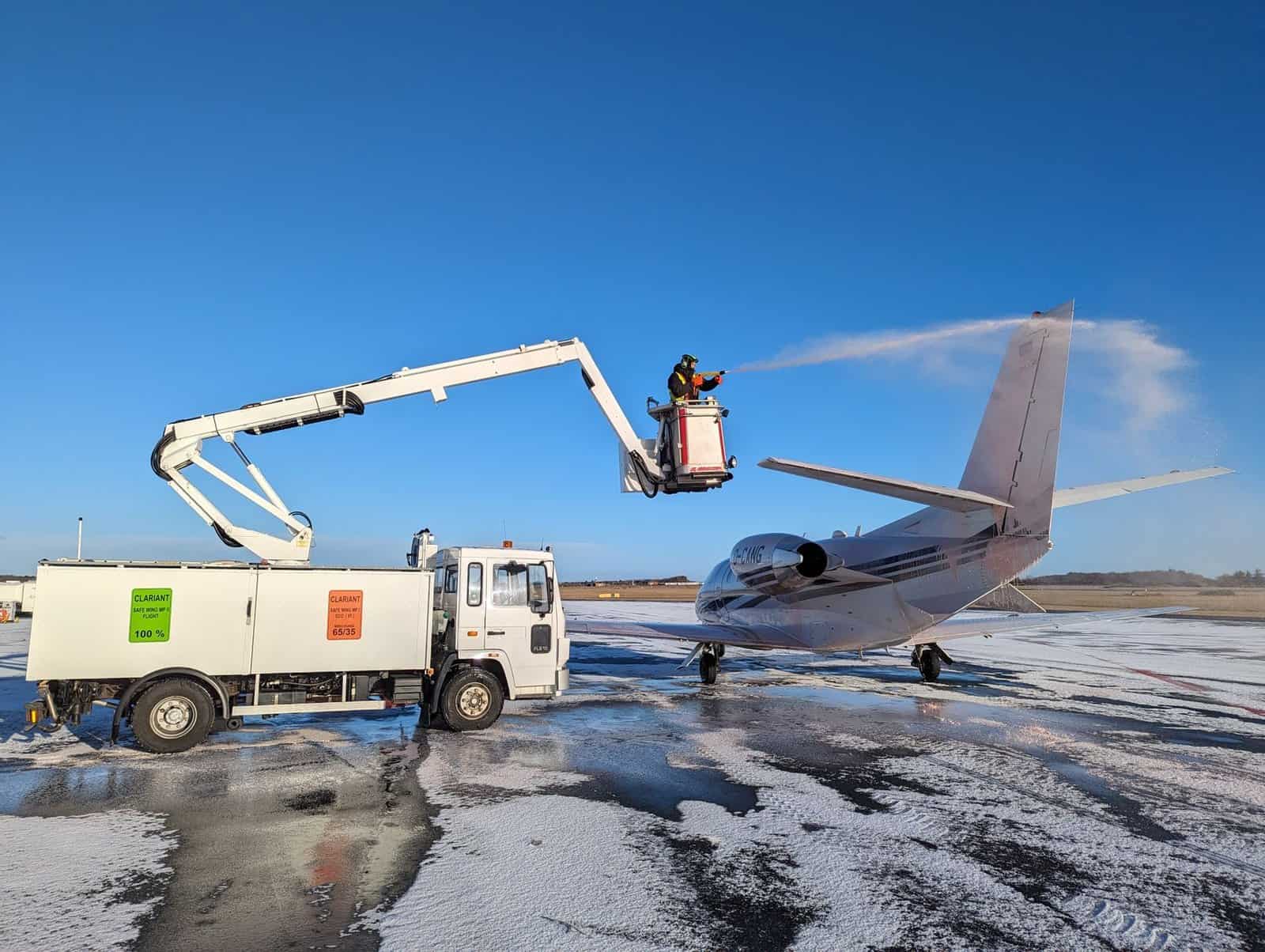
Most de-icing in North America uses a two-step process with two kinds of fluid.
Type I fluid: orange and hot
Type I is a thin, glycol-based fluid, usually dyed orange, that’s heated and sprayed at high pressure. American Airlines describes heating it to about 140°F. Its job is to melt and blast off snow, ice, and frost that has already built up. Because it’s thin, it runs off the aircraft quickly and gives only brief protection against new ice. The FAA’s guidance notes that Type I’s holdover time is considerably shorter than that of thickened fluids. Under FAA holdover tables, Type I times range from about 1 to 22 minutes, depending on conditions.
Type IV fluid: green and sticky
Type IV is a thickened anti-icing fluid, usually dyed green. It’s applied after the plane is clean, and it clings to the wings while the plane sits or taxis, absorbing falling snow and keeping it from freezing to the surface. During the takeoff roll, airflow shears it off the wing. Type IV gives much longer protection, ranging from about 9 minutes to more than two hours in FAA tables, depending on temperature and what’s falling from the sky.
The clock starts at the spray
Holdover time begins at the final application of fluid. The length depends on outside temperature, the type and intensity of precipitation (frost, light snow, heavy snow, freezing drizzle, freezing rain), and how diluted the fluid is. Pilots use FAA-published tables to figure out how much time they have.
If the plane sits too long in a taxi line or behind a ground stop and the holdover time runs out, the crew must return for another treatment. In heavy freezing rain or certain mixed precipitation, holdover times can become so short, or nonexistent, that de-icing operations pause altogether. American Airlines has noted that in some severe conditions this can temporarily halt ground operations at an airport.
What Happens on Board While You Wait
If you’ve sat on a plane during de-icing, you’ve seen a few things that seem odd. Here’s what’s going on:
- The engines may be off and the auxiliary power unit running, so the cabin has power and lights.
- The air conditioning packs are often turned off to keep fluid fumes out of the cabin, which is why the cabin can feel stuffy or you may notice a faint smell.
- The flaps and slats on the wing are usually set for takeoff before spraying.
- The ground crew tells the pilots which fluids were used and when treatment began, so the crew can calculate holdover time.
- You may hear trucks moving around the plane and see orange or green fluid streaming off the wing.
Why De-Icing Delays Spread Across the Day
At a big airport in a storm, the delays snowball for a few reasons.
Limited equipment. Airports and airlines have a set number of de-icing trucks and pads. When every departing flight needs treatment, there’s a queue, and each plane takes time to spray.
Slower runways. Snow removal and reduced braking action can slow the rate of takeoffs and landings, which makes taxi lines longer and eats into holdover times.
Re-treatments. Every plane that times out has to go back through, which adds to the queue.
Knock-on effects. A plane that leaves late arrives late at its next stop, so a morning storm in Chicago can delay an afternoon flight in Atlanta.
Some airports use centralized de-icing pads near the runways so planes can be sprayed close to takeoff and leave right away, cutting the time between spray and departure. That helps, but it can’t make up for heavy snow plus full schedules.
Frost Delays on Clear Mornings
De-icing isn’t only for storms. On clear, cold nights, planes parked outside can collect frost on their wings, even when the temperature at ground level is slightly above freezing. That’s why your 6 a.m. flight on a sunny winter morning may still need de-icing before departure.
Frost removal is usually quicker than storm de-icing, often using only Type I fluid, but it can still add 10 to 30 minutes on a busy morning when many planes need it at once.
How to Plan Around Winter De-Icing Delays
You can’t control the weather, but you can make de-icing delays hurt less:
- Allow longer connections in winter. A 45-minute connection that works in July can vanish after a de-icing delay in January.
- Consider routing through warmer hubs in winter when you have a choice, though no hub is immune to winter weather.
- Book early flights for the best odds, but expect frost de-icing on cold mornings.
- Watch the forecast for freezing rain and freezing drizzle in particular. Those conditions cause the shortest holdover times and the longest disruptions.
- Use airline weather waivers to move your flight ahead of a storm when they’re offered.
- Stay on board and listen to the crew. Getting off a plane during a de-icing delay usually isn’t an option once it has left the gate.
Why Airlines Don’t Just Spray Earlier
It’s natural to wonder why airlines don’t de-ice planes at the gate before boarding to save time. The answer is the holdover clock. Spraying a plane before a 30-minute boarding process, then taxiing, could use up much of the fluid’s protection before takeoff, especially in active snow. Spraying as close to departure as possible gives the best margin of safety.
That’s also why de-icing happens with passengers on board. It’s not that airlines want you sitting there. It’s that the fluid has to be fresh when the wheels leave the ground.
Which Airports See the Most De-Icing
Any airport that gets winter weather de-ics planes, but some do it on a huge scale every season. Major hubs in the upper Midwest and Northeast, such as Chicago O’Hare, Minneapolis-St. Paul, Detroit, Boston, and the New York airports, treat thousands of flights each winter and have large de-icing fleets and pads. Airports in places like Denver and Salt Lake City also de-ice often because of high-altitude snow.
Airports that rarely see ice can actually struggle more. When a rare ice storm hits a Southern city, the airport may have fewer trucks, less fluid on hand, and less practice, so a single icy morning can cause big delays. That’s one reason ice storms in places like Dallas or Atlanta can snarl national air travel.
What You Can Do on the Plane
If you’re sitting through a de-icing delay, a few things help:
- Use the time to check your connection in the airline app, and look at rebooking options before you land.
- Keep your seatbelt fastened. The plane may move suddenly between the de-icing area and the runway.
- Expect to see orange or green fluid streaming past the window and possibly a faint smell in the cabin. Both are normal and short-lived.
- Stay hydrated and keep snacks handy. A long de-icing line plus a runway queue can stretch past an hour on a bad storm day.
- Ask a flight attendant if your connection is at risk. They can sometimes share information from the cockpit.
Where the Fluid Goes
De-icing fluid is mostly propylene glycol mixed with water. Many large airports collect spent fluid with drainage systems at de-icing pads and send it for treatment or recycling, rather than letting it run into nearby waterways. If you see a plane being sprayed on a designated pad instead of at the gate, environmental rules are part of the reason.
The Short Version
De-icing delays happen because the fluid that keeps wings clean only works for a limited time, and that time shrinks as weather gets worse. Planes have to be sprayed at the last moment, with passengers aboard, and sprayed again if takeoff takes too long. On a stormy day at a busy airport, those steps stack into real delays. Leave extra connection time in winter, watch for freezing rain, and know that the wait is the price of a wing that can actually lift the plane.