Chattanooga’s Southside Was Warehouses and Empty Lots 20 Years Ago. Now It’s the Most Expensive Place to Rent in the City.
We may earn money or products from the companies mentioned in this post. This means if you click on the link and purchase the item, I will receive a small commission at no extra cost to you ... you're just helping re-supply our family's travel fund.
Twenty years ago, Chattanooga’s Southside was mostly abandoned rail infrastructure, low-slung warehouses, and surface parking lots south of the downtown core. The North Shore, across the Tennessee River, was a modest residential strip with a handful of independent shops. Today both neighborhoods anchor the city’s identity as a revitalized mid-sized Southern city, and Southside in particular has become one of the priciest places in Chattanooga to rent an apartment, a total inversion of what the area represented a generation ago.
From Rail Yards to Rooftop Bars
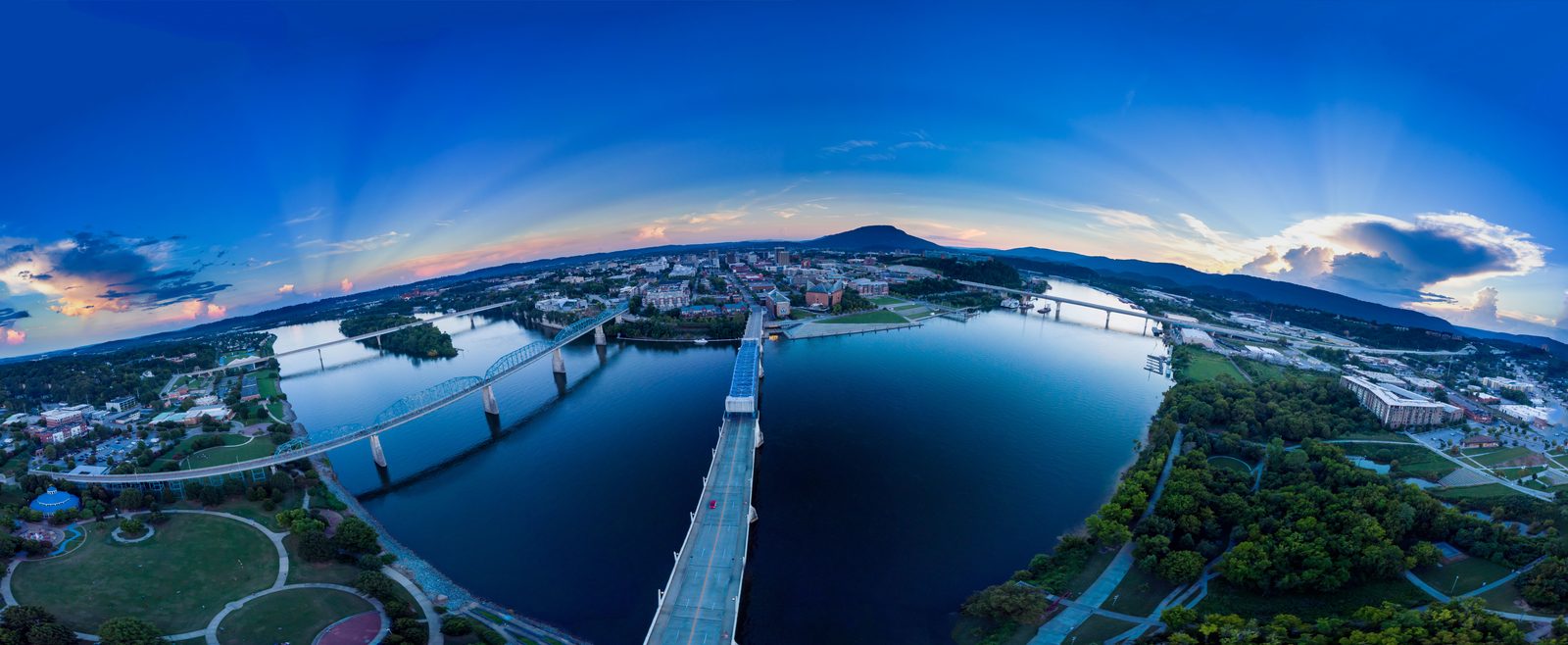
Southside’s turnaround tracked Chattanooga’s broader civic strategy through the 2000s and 2010s: convert underused industrial land near downtown into mixed-use development anchored by breweries, restaurants, and adaptive-reuse residential buildings. The neighborhood’s identity now centers on Station Street and the area around the old Chattanooga Choo-Choo terminal, itself converted decades earlier into a hotel and entertainment complex that presaged the district-wide transformation. Developers have built or converted warehouse shells into loft apartments, and mixed-use projects, including a $25 million community announced in 2020, have continued adding density to a neighborhood that had almost none twenty years prior.
That density came with price appreciation that tracks almost exactly with the neighborhood’s rising profile. Rental listings in Southside have climbed from a figure closer to $900 to $1,200 a month for the neighborhood a decade ago toward rates now competitive with or exceeding downtown Chattanooga proper, driven by demand for walkable access to the district’s restaurant and brewery corridor.
North Shore’s Parallel Track
Across the Walnut Street Bridge, one of the world’s longest pedestrian bridges and itself a symbol of the city’s broader riverfront revitalization dating back to the 1990s, the North Shore followed a gentler version of the same trajectory. Frazier Avenue became the neighborhood’s commercial spine, lined with independent boutiques, coffee shops, and restaurants that replaced what had been a sleepier residential strip. The North Shore never had Southside’s industrial infrastructure to convert, so its growth has been more incremental, small-scale infill and storefront turnover rather than large adaptive-reuse projects, but the net effect on desirability and price has moved in the same direction.
What Drove the Turnaround
- The city’s early investment in Gig-speed municipal fiber internet, built out starting in the late 2000s, made Chattanooga an early draw for remote workers and small tech firms
- Proximity to the Tennessee Riverwalk and the Tennessee Aquarium gave both neighborhoods a built-in amenity base that predated their residential booms
- Adaptive reuse of industrial buildings gave Southside a distinctive architectural identity that new construction alone couldn’t replicate
Chattanooga’s broader civic strategy through this period deserves credit for creating the conditions that made Southside and North Shore’s individual transformations possible. The city’s 21st Century Waterfront Plan, launched in the early 2000s, coordinated investment across the Tennessee Aquarium, the Hunter Museum of American Art, and the riverfront green space connecting them, establishing a critical mass of destination-worthy public space that private investment in Southside and North Shore could then build outward from. Neither neighborhood transformed in isolation; each benefited from a citywide bet on downtown density that started before either district had its current identity.
The city’s famous municipal fiber network, built by the publicly owned utility EPB starting in 2010, gave Chattanooga a marketing hook, the Gig City, that extended well beyond internet speed bragging rights into an actual talent-recruitment tool for the tech and remote-work-friendly employers now filling office and residential space in both Southside and downtown proper. That infrastructure investment is frequently cited in relocation coverage as a differentiator that separates Chattanooga’s revitalization story from comparable mid-sized Southern cities pursuing similar downtown strategies without a comparable digital infrastructure advantage.
What’s harder to quantify, but shows up constantly in resident interviews and local reporting, is the psychological shift in how Chattanoogans talk about their own city. A generation ago, Chattanooga’s civic self-image was shaped by its 1969 designation, only half-jokingly worn as a badge of dysfunction, as one of the most polluted cities in America due to its steel industry emissions. The Southside and North Shore transformations are frequently cited locally not just as real estate success stories but as proof of a broader identity shift, from an industrial city apologizing for its air quality to a outdoor-recreation and remote-work destination that markets its river, its mountain biking trails, and its downtown walkability as the primary pitch.
Visitors exploring Southside today will find the neighborhood anchored by the Chattanooga Choo Choo complex, a restored 1909 train terminal converted into a hotel and entertainment venue, alongside the Warehouse Row shopping district and a dense cluster of breweries and restaurants that occupy buildings still bearing the painted ghost signs of the manufacturing tenants that used them decades earlier, a visual reminder, still legible if you look up while walking the neighborhood, of exactly how recent and how total this transformation has been.
The neighborhood’s transformation has not been without local tension of its own, echoing the debates playing out in gentrifying districts nationwide: rising commercial rents have already pushed out a handful of the original, lower-margin businesses that helped establish Southside’s early identity before the district became fashionable, a familiar pattern in which the pioneers of a neighborhood’s revival often can’t afford to remain once that revival succeeds.
Music venues have followed a similar trajectory in Chattanooga’s downtown core, with mid-sized rooms and outdoor amphitheater space added specifically to capture touring acts that once routinely skipped the city in favor of Nashville or Atlanta, a booking pattern shift that itself reflects promoters’ recognition that Chattanooga’s audience and infrastructure had both grown enough to support acts the city couldn’t have justified filling a room for a generation ago.
The tradeoff Chattanooga now faces is a familiar one for any mid-sized city that successfully revitalizes its urban core: the neighborhoods that were cheap enough to redevelop twenty years ago are no longer cheap, and the affordability that once defined Chattanooga’s appeal relative to Nashville or Asheville has started to erode in exactly the districts that made the city attractive in the first place. Southside and North Shore are proof the strategy worked. They’re also proof of what working looks like once the prices catch up to the ambition.