Baltimore Is Not The Wire and It Is Not the Inner Harbor Either. Almost Nobody Outside Maryland Has Seen the Real Version
We may earn money or products from the companies mentioned in this post. This means if you click on the link and purchase the item, I will receive a small commission at no extra cost to you ... you're just helping re-supply our family's travel fund.
Baltimore’s national image is stuck between two extremes that don’t actually describe most of the city. There’s the Inner Harbor version — aquarium, tourist boats, chain restaurants — built for out-of-towners who never leave a ten-block radius. And there’s the version shaped by two decades of prestige television about drugs and violence, which, however well-made, froze Baltimore’s reputation somewhere around 2008. Neither has much to do with Hampden’s rowhouse-lined streets, Fell’s Point’s cobblestone waterfront bars, or the Charles Village blocks around Johns Hopkins where the city’s actual daily life happens.
The neighborhoods that don’t fit either narrative
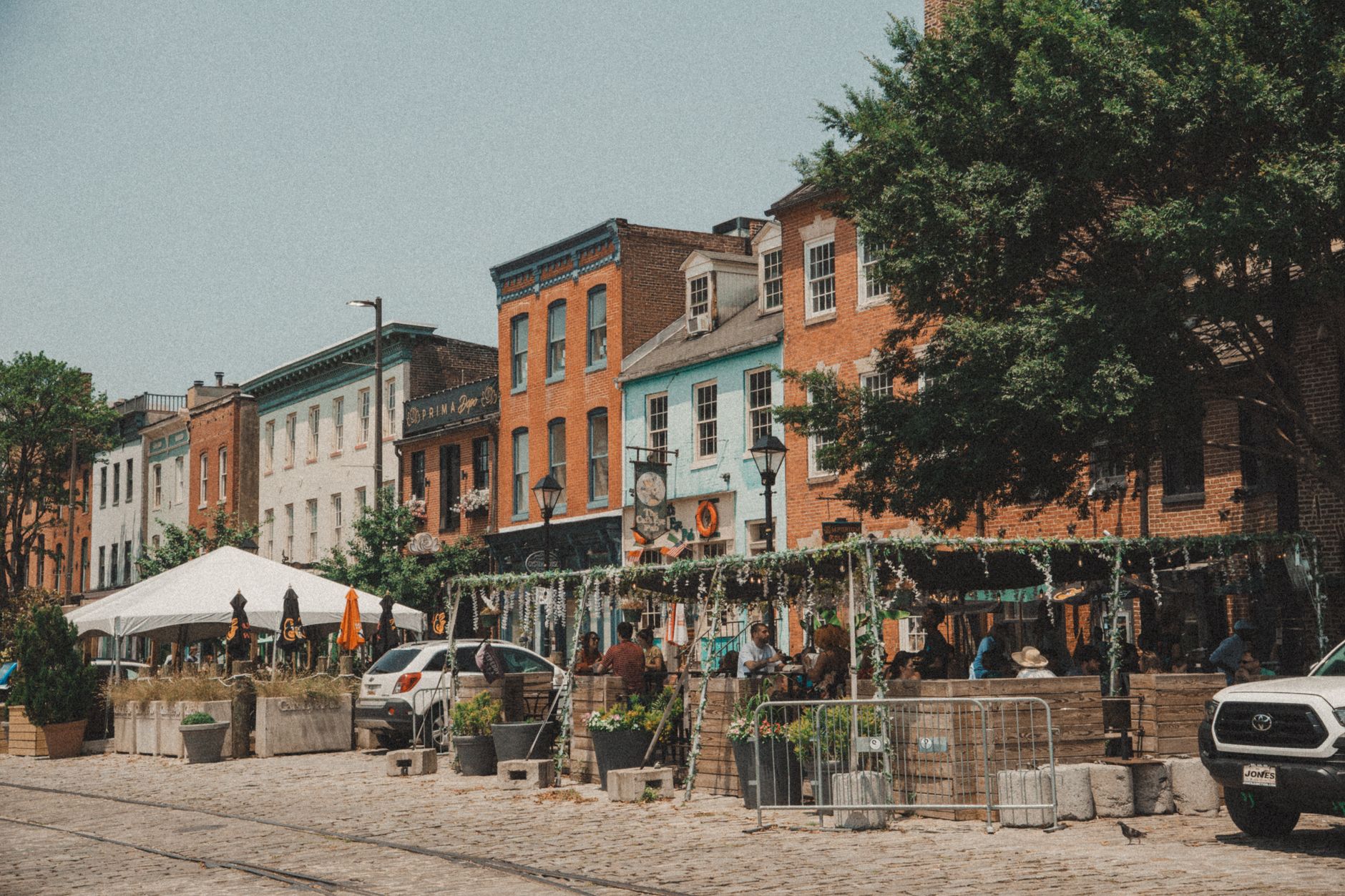
Hampden is the clearest example of a Baltimore neighborhood that TV never covered and tourists rarely find without specifically looking for it. It’s a former mill worker neighborhood along the Jones Falls that turned its main strip, The Avenue, into a corridor of vintage shops, indie restaurants, and the annual HonFest celebration of Baltimore’s “hon” culture — a genuinely local piece of civic identity that has nothing to do with crime statistics or aquarium gift shops. Federal Hill offers a similar story with better harbor views and a younger, rowdier bar scene. Fell’s Point, one of the oldest neighborhoods in the city, has cobblestone streets, historic taverns dating to the 18th century, and a working waterfront feel that the Inner Harbor’s built-for-tourists version never quite captures.
Johns Hopkins University and Johns Hopkins Hospital together form one of the largest employers in Maryland, and the neighborhoods around the university — Charles Village, Remington — have developed the kind of coffee shop and bookstore density that comes from a stable base of students, researchers, and medical staff rather than tourism dollars. This is the least-photographed version of Baltimore and also, arguably, the most functional.
What actually changed and what didn’t
Baltimore’s population has declined for decades, from a peak above 950,000 in 1950 to roughly 565,000 today, and the city still faces real, well-documented challenges around vacant housing stock and violent crime rates that remain elevated compared to national averages, particularly in specific East and West Baltimore neighborhoods. Pretending otherwise would be dishonest. But those challenges are heavily concentrated geographically, in ways that most cities’ problems are — the same is true of parts of Chicago, St. Louis, and Memphis — and the neighborhoods carrying that burden are largely not the ones a visitor would ever pass through.
What’s actually there now
- Hampden’s Avenue, especially during HonFest in June
- Fell’s Point’s historic bars and waterfront promenade
- The American Visionary Art Museum, one of the more genuinely unusual museums on the East Coast
- Federal Hill Park, with one of the best skyline views in the city
- Lexington Market, recently renovated, one of the oldest continuously operating public markets in the country
Why the reputation lags the reality
The food scene that developed away from the tourist zones
Baltimore’s food identity runs deeper than crab cakes at the Inner Harbor, though the crab cakes are genuinely good if you know where to go — Faidley’s inside Lexington Market has been serving them since 1886. Hampden and Highlandtown have developed real dining scenes built for locals rather than convention visitors, with a strong Greek food tradition in Greektown on the east side, dating back to Greek immigration in the early 20th century, and a growing Ethiopian and Latin American food presence reflecting the city’s more recent immigrant communities. None of this shows up in a typical two-day visit built around the aquarium and the harbor, which is exactly the point — it requires actually leaving the tourist perimeter.
Baltimore’s row house architecture, largely built between the 1870s and 1920s to house factory and shipping workers, gives huge stretches of the city a visual consistency that few other East Coast cities can match, and neighborhoods like Bolton Hill and Reservoir Hill retain block after block of largely intact historic housing stock, some restored, some still waiting. That architectural density, combined with relatively low property costs compared to Washington D.C. just forty miles south, has drawn a steady trickle of buyers priced out of the capital, slowly reshaping neighborhoods that spent decades losing population rather than gaining it.
Baltimore’s relationship to Washington D.C., just forty miles south, increasingly shapes its future as much as its own internal history does. Commuters who work in the capital but can’t afford D.C. or Northern Virginia housing costs have started looking at Baltimore neighborhoods along the MARC train line, which offers a direct rail commute into Union Station, opening up parts of the city to a buyer pool that didn’t previously consider it. That dynamic mirrors what happened to parts of New Jersey and Philadelphia relative to New York City a generation earlier, and it’s slowly reshaping neighborhoods near the train stations even as the deeper structural issues in other parts of the city remain largely untouched by that specific investment wave.
The city’s sports culture also offers a version of civic identity that has nothing to do with either extreme of its reputation — Camden Yards, opened in 1992, is widely credited with sparking the retro-ballpark trend that reshaped stadium design across Major League Baseball, and Orioles and Ravens games remain genuine unifying events across a city that can otherwise feel divided along neighborhood and economic lines.
A prestige TV show that aired its final episode in 2008 is still, for a meaningful share of Americans, their primary mental model of an entire city seventeen years later — that’s an unusually long half-life for a cultural reference to dominate a place’s reputation. Meanwhile the Inner Harbor’s tourist infrastructure, built in the 1980s specifically to counter Baltimore’s declining image, created its own distortion by presenting a sanitized, corporate version that locals mostly avoid. The actual city sits in between, doing what mid-size East Coast cities with strong universities and historic housing stock generally do: getting steadily better in specific neighborhoods while the national conversation stays anchored to an old storyline.