Up to 4,000 Bald Eagles Crowd One Alaska River Every November. Here’s Why They Pick Haines
We may earn money or products from the companies mentioned in this post. This means if you click on the link and purchase the item, I will receive a small commission at no extra cost to you ... you're just helping re-supply our family's travel fund.
Every fall, somewhere between 3,000 and 4,000 bald eagles pile into a few miles of river bottom outside a town of about 2,000 people. The Haines Alaska bald eagles gathering is the largest concentration of the species anywhere, and the reason is not scenery. It is plumbing.
Here is the short answer. A stretch of the Chilkat River near the village of Klukwan stays open water deep into winter because warmer groundwater wells up from a huge underground gravel fan. That open water keeps a late run of chum salmon available long after other rivers in Southeast Alaska have frozen over. Eagles go where the food is, and in November the food is here.
The numbers swing year to year. State park planners note the highest counts reached about 4,000 in the 1980s, while typical winter concentrations run 2,000 to 3,000. Tourism sources commonly cite “more than 3,000” from October through February, and the peak usually lands between mid-November and mid-December. Either way, you are not looking at a few birds in a tree. You are looking at cottonwoods so loaded with eagles that the branches look decorated.
Here’s Why the Eagles Pick Haines
The Chilkat River runs out of British Columbia and down a broad glacial valley to Lynn Canal, the long fjord that Haines sits beside. Where the Tsirku River meets the Chilkat, decades of glacial runoff dropped an enormous fan of gravel and sand. That fan works like a giant sponge. It soaks up water in summer and fall, holds it underground where it stays slightly warmer than the air, and then seeps it back into the Chilkat through the winter.
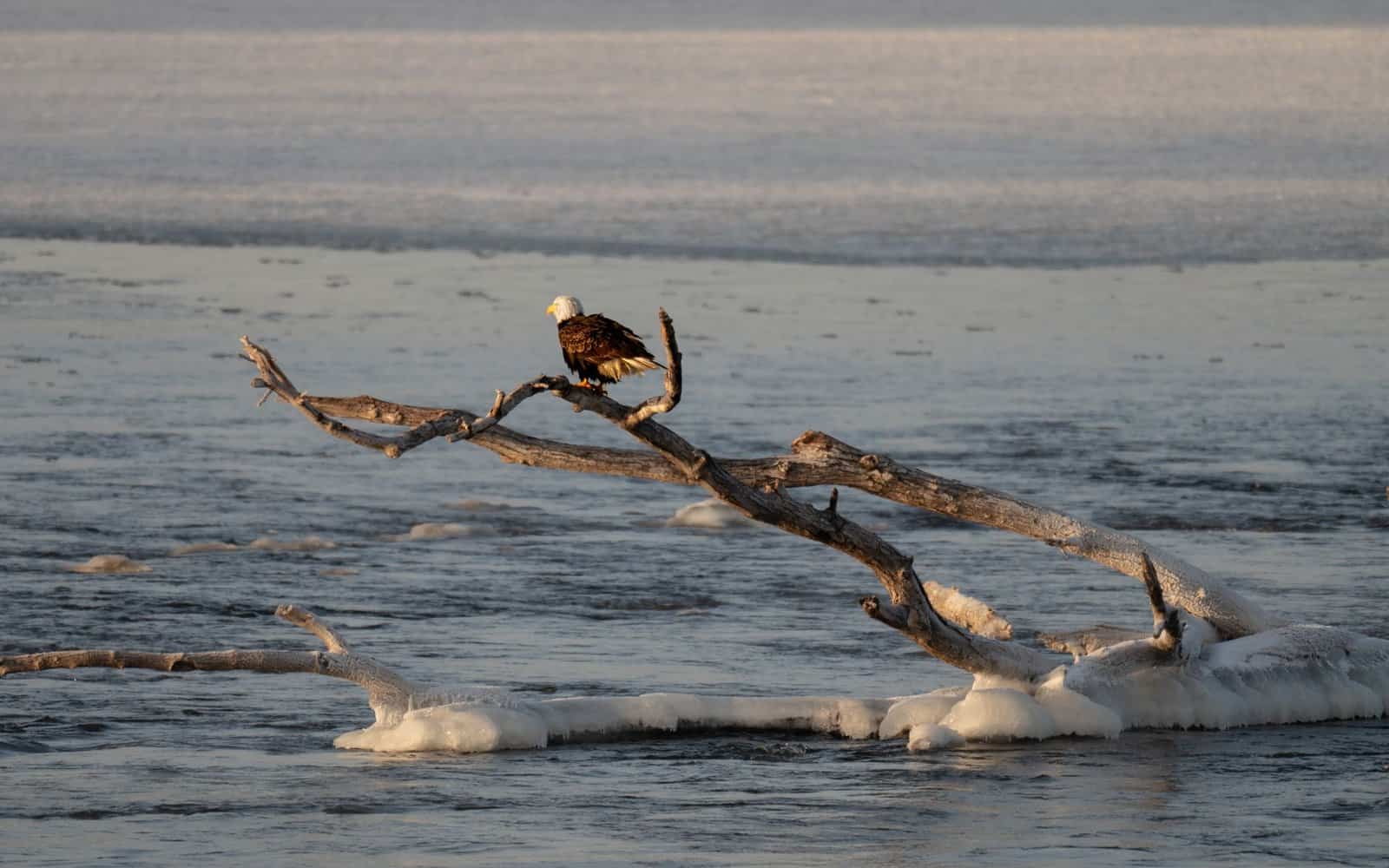
That upwelling water stays above freezing. As temperatures drop and the rest of the river skins over with ice, a roughly five-mile section stays open. Alaska’s Department of Fish and Game describes it plainly: the ice-free water keeps salmon runs available and attracts more than 3,000 eagles between mid-October and January.
The salmon matter as much as the water. Most Alaska salmon runs finish by late summer or early fall. The Chilkat gets a late run of chum and some coho that spawn well into the cold months. Spawned-out salmon die and wash up on gravel bars, which gives eagles an easy, high-calorie meal at the exact moment food gets scarce everywhere else.
Put those two facts together and you get a winter buffet in a region where most tables have closed. Eagles fly in from across Southeast Alaska, from British Columbia, and from the Yukon. Some are residents, since the valley supports a year-round population in the low hundreds and more than 80 nests have been documented in the preserve. Most are visitors who arrived for one reason.
Where to Watch the Haines Alaska Bald Eagles
The state created the Alaska Chilkat Bald Eagle Preserve in 1982 to protect this habitat. It covers about 48,000 acres of river bottom, forest, and mountainside. The part you care about sits along the Haines Highway, the road that runs from town toward the Canadian border.
- The prime viewing stretch runs roughly from Mile 18 to Mile 24 of the Haines Highway, often called the Council Grounds.
- Pullouts and short walkways along the river let you stop safely off the road.
- The village of Klukwan, a Tlingit community, sits near the heart of the gathering, so treat the area as someone’s home, not a backdrop.
- Mile 8 through 31 of the highway is generally considered the broader eagle corridor.
You do not need a boat or a guide to see eagles. On a good day in November you can pull over, step out, and count dozens in a single look. Birds perch in bare cottonwoods, stand on gravel bars tearing at salmon, and squabble over carcasses in the shallows. The sound surprises people. Bald eagles have a high, chattering call that is nothing like the screaming hawk dubbed over them in movies.
A guided tour still has value. Local naturalists know which bars are active that week, carry spotting scopes, and can explain behavior you would otherwise miss, like juveniles in their mottled brown plumage learning to compete with adults. Land-based tours operate in winter, and some photography outfitters run longer outings for people who want to work the light.
When to Go and What the Weather Is Like
If you want the biggest numbers, aim for mid-November. That is when the Alaska Bald Eagle Festival takes place in Haines, usually during the second week of the month, timed to the typical peak. The festival runs several days and includes guided trips to the preserve, talks, photography workshops, and the release of rehabilitated eagles back into the wild. It is a small-town event, so lodging fills early.
Eagles hang around later than many people expect. Good numbers often persist into December, and smaller concentrations linger into February. If you would rather trade a few hundred birds for fewer people, early December is a reasonable bet.
The weather is the real wild card. Expect temperatures that hover around freezing in town and drop lower up the valley, wind off Lynn Canal, short daylight, and a decent chance of rain, sleet, or snow on any given day. Days in Haines in late November run only about seven hours long, and the sun stays low. That low light is lovely for photographs, but it means you have a short window.
Pack the way locals do:
- Waterproof insulated boots with good grip for icy pullouts.
- A warm hat, gloves you can operate a camera in, and a second pair to swap when the first gets wet.
- Layers under a windproof, waterproof shell.
- Binoculars, even if you plan to shoot photos.
- A thermos, since there is not much open along the highway.
How to Get to Haines in Winter
Haines is one of the few towns in Southeast Alaska connected to the road system, but “connected” is relative. The Haines Highway runs about 150 miles north to Haines Junction in the Yukon, where it meets the Alaska Highway. Driving in from Anchorage or Fairbanks means a long winter road trip through Canada with a passport, winter tires, and plenty of daylight planning.
Most visitors arrive by water or air instead. The Alaska Marine Highway ferry connects Haines with Juneau and Skagway, though winter schedules are thinner than summer ones and can change. Small air carriers fly between Juneau and Haines in about 45 minutes, weather permitting. In practice, a lot of eagle visitors fly into Juneau on a jet, then hop over on a small plane or ferry.
Lodging is limited and mostly small: a handful of inns, motels, bed-and-breakfasts, and cabins. Rooms in town often run roughly $120 to $200 a night in the off-season, and festival week books up months ahead. Restaurants keep shorter winter hours, so check what is open before you assume dinner will be easy.
How to Watch Without Disturbing the Birds
Eagles burn a lot of energy staying warm in winter. Every time a person flushes them off a carcass, they lose a meal they badly need. Good viewing etiquette is not about manners. It directly affects their survival.
- Stay on the road shoulder, pullouts, and designated walkways rather than walking out onto the river flats.
- Keep voices low and avoid sudden movement toward perched birds.
- Use a long lens or binoculars instead of trying to get close.
- Never feed eagles or bait them for photos.
- Pull completely off the highway before stopping, since logging and freight trucks use it in winter.
Drones are a particularly bad idea here. Wildlife rules and park management plans restrict activities that harass birds, and an eagle that feels threatened by a buzzing aircraft will leave a feeding site entirely. Leave the drone in the bag.
Photographing the Eagles in Low Winter Light
Photographers come to Haines from around the world in November, and the conditions reward patience more than gear. The sun barely clears the mountains in late fall, so light stays soft and golden for much of the short day. That flatters white heads and dark feathers, but it also means fast shutter speeds take work.
- A telephoto lens in the 300mm to 600mm range lets you fill the frame from the road shoulder.
- A monopod or beanbag on a car window keeps long lenses steady in the cold.
- Spare batteries matter, because cold drains them quickly. Keep extras in an inside pocket.
- Overcast days are common. Raise your ISO rather than giving up on the session.
- Snow on the cottonwoods makes the best images, so a fresh storm is good news, not bad.
The most dramatic moments usually happen on the gravel bars, where birds land to feed and squabble. Watch for an eagle lifting off with a salmon while others give chase. You will see the behavior repeat, so if you miss one shot, stay put and wait for the next. Many photographers spend hours at a single pullout rather than driving up and down the highway.
Why the Chilkat Gathering Matters Beyond the Spectacle
Bald eagles were once scarce across much of the Lower 48 because of habitat loss, shooting, and the pesticide DDT, which thinned their eggshells. Alaska held one of the healthiest populations through those years, and the Chilkat Valley was one reason. Protecting the preserve meant protecting the one place where thousands of birds could reliably get through the hardest part of the year.
The gathering also ties directly to the health of salmon. If the late chum run falters, the eagles will not come in the same numbers. That makes the November count a kind of report card on the river itself, watched by biologists, the Klukwan community, and the Haines residents who have built a modest winter economy around a bird most Americans have only seen on a coin.
For you, the takeaway is simple. Come in mid-November, dress like it is winter, stay on the shoulder, and give yourself at least two days in case weather wipes one out. The birds keep their own schedule, but they have kept it for a very long time.