Petrified Forest Is the Only National Park With a Stretch of Route 66. 7 Stops Worth Pulling Over For
We may earn money or products from the companies mentioned in this post. This means if you click on the link and purchase the item, I will receive a small commission at no extra cost to you ... you're just helping re-supply our family's travel fund.
Petrified Forest National Park in northeastern Arizona is the only park in the entire National Park System that contains a section of historic Route 66, according to the National Park Service. A line of weathered telephone poles still marks where the old highway crossed the park, and a vintage car sits at the spot as a reminder. That makes the Petrified Forest Route 66 stop one of the most unusual roadside pullouts in the West.
The Mother Road crossed this stretch of desert from 1926 until 1958, and for millions of travelers it was their first look at the Painted Desert and its fossil logs. Today, Interstate 40 has replaced Route 66, but the park’s main road still connects the north and south ends in about 28 miles, with overlooks, short trails, and history stops along the way.
You can drive the park in a couple of hours, but you will miss the best parts if you do not stop. Here are seven pullouts worth your time, roughly in order from north to south.
Driving the Petrified Forest Route 66 corridor
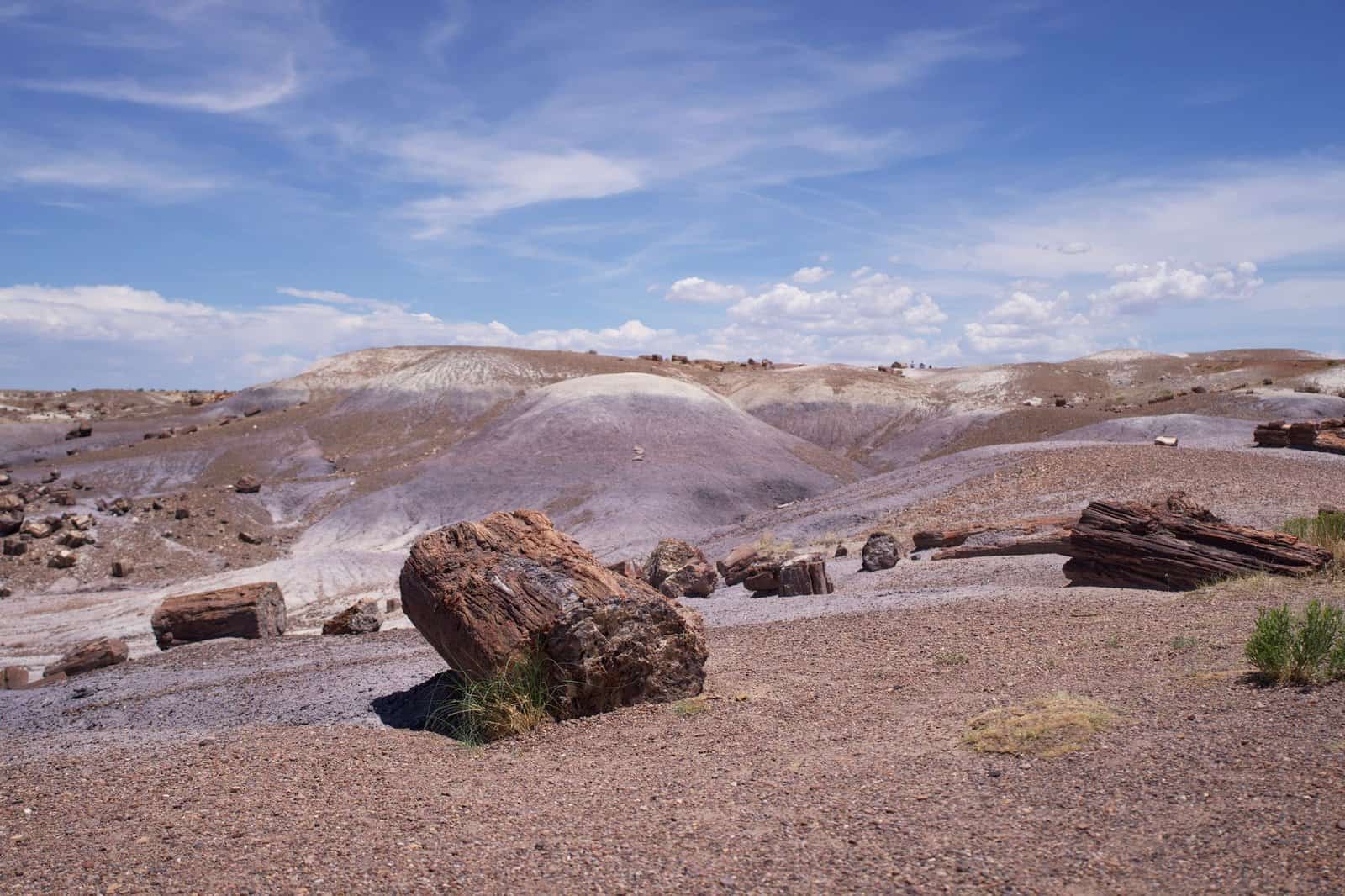
The park has two entrances: the north entrance off I-40 near the Painted Desert Visitor Center, and the south entrance on U.S. 180 near Holbrook. Most visitors drive through in one direction and connect back to I-40. If you are traveling east to west on I-40, start at the north end. If you are coming from Holbrook, start at the south end and reverse this list.
1. The Route 66 marker and the 1932 Studebaker
A few miles south of the north entrance, the park road crosses the old alignment of Route 66. A historical marker titled “Highway of Dreams” explains that this stretch was open from 1926 until 1958 and was the primary way millions of travelers first experienced the park.
Beside the marker sits a rusting 1932 Studebaker, placed there as a nod to the road’s heyday. Look east and west, and you will see a line of old telephone poles stretching across the grassland, tracing the path of the former highway. It is a quiet spot and one of the few places in the country where Route 66 history sits inside a national park.
2. The Painted Desert Inn
The Painted Desert Inn at Kachina Point is a National Historic Landmark and once served as a rest stop for travelers on Route 66. The building, with its Pueblo Revival architecture, was rebuilt in the 1930s by the Civilian Conservation Corps and later operated by the Fred Harvey Company, which ran hotels and restaurants for railroad and highway travelers across the Southwest.
Inside, you will find murals painted in 1949 by Hopi artist Fred Kabotie, depicting Hopi life and traditions. The inn now serves as a museum and bookstore. Check the NPS website for current hours, since they can be reduced outside peak season.
3. The Painted Desert overlooks
The northern part of the park is all about the Painted Desert, a wide expanse of badlands striped in red, orange, purple, and gray. Several overlooks along the road give sweeping views, including Tiponi Point, Tawa Point, Kachina Point behind the Painted Desert Inn, and Nizhoni Point.
The colors change throughout the day. Early morning and late afternoon light bring out deeper reds and purples, while midday light can flatten the colors. If you only have time for a couple of overlooks, Kachina Point and Tiponi Point are good choices.
4. Puerco Pueblo
Puerco Pueblo is the remains of a village of about 100 rooms built by Ancestral Puebloan people and occupied roughly between the 1200s and 1400s. A short paved trail loops through the excavated walls and past boulders covered in petroglyphs.
One petroglyph here is known for interacting with sunlight around the summer solstice, when a beam of light touches a particular spot on the carving. Even outside the solstice, the site gives a sense of how people lived in this landscape long before Route 66 or the national park existed.
5. Newspaper Rock
Just south of Puerco Pueblo, Newspaper Rock is an overlook above a cluster of boulders covered in more than 650 petroglyphs, according to the park. The images include human figures, animals, spirals, and symbols carved over many centuries.
You cannot walk down to the rocks. The area below the cliff is closed to protect the petroglyphs and because of unstable slopes. Spotting scopes at the overlook help you see the details. Bring binoculars if you have them.
6. Blue Mesa
Blue Mesa is one of the most visually striking areas in the park. A 3.5-mile spur road leads to viewpoints over bands of blue, purple, and gray badlands, and the Blue Mesa Trail drops into the formations on a loop of about a mile. Along the trail, you will see petrified logs resting on top of eroding hills.
The trail includes a steep descent at the start, so it is a good leg stretch with some effort. In winter, the clay can be slick after rain or snow, so wear shoes with good grip.
7. Agate Bridge and the Giant Logs at Rainbow Forest
Agate Bridge is a petrified log about 110 feet long that spans a small ravine. In the early 1900s, a concrete support was poured beneath it to keep it from collapsing, a reminder of how early preservation efforts sometimes looked very different from today’s standards.
At the south end of the park, the Rainbow Forest Museum is the starting point for the Giant Logs Trail, a short loop behind the museum with some of the largest and most colorful petrified logs in the park. One of them, nicknamed “Old Faithful,” is among the biggest. Nearby, the Long Logs and Agate House trails lead to more concentrations of petrified wood and a partially reconstructed pueblo built from petrified wood.
How the wood became stone
The logs at Petrified Forest are the remains of trees that grew in the Late Triassic period, more than 200 million years ago, when this region was part of a tropical river system. Fallen trees were buried quickly in sediment rich in volcanic ash. Groundwater carrying silica seeped into the wood and gradually replaced the plant material with quartz.
Iron, manganese, and other minerals created the colors you see today: reds, yellows, purples, and blacks. Over millions of years, erosion exposed the logs at the surface.
Do not take any petrified wood
It is illegal to remove petrified wood or any other natural or cultural objects from the park. Small pieces may seem harmless to take, but with hundreds of thousands of visitors each year, even small losses add up. If you want a souvenir, shops outside the park sell petrified wood collected legally from private land.
Route 66 beyond the park
After the park, it is easy to keep following Route 66 history nearby. Holbrook, about 20 miles from the south entrance, is known for the Wigwam Motel, where guests sleep in concrete teepee-shaped rooms built in the 1950s. Farther west, Winslow has the “Standin’ on the Corner” park inspired by the Eagles song “Take It Easy.” To the east, the old highway continues toward Gallup, New Mexico.
Practical tips
A few things to know before you go:
- Time needed: Plan at least two to three hours to drive the park with stops. A half day lets you hike several short trails.
- Hours: The park road is not open 24 hours. Gates open and close on a seasonal schedule, so check current hours before you go.
- Fees: There is a per-vehicle entrance fee, and the America the Beautiful pass covers it.
- Food: Options inside the park are limited. The Painted Desert Visitor Center area and Rainbow Forest area have small concessions, but hours vary.
- Weather: Winters can be cold and windy, with occasional snow. Summers are hot. Spring can be very windy.
- Pets: Leashed pets are allowed on paved trails and in many areas of the park.
A simple itinerary
If you are driving I-40 westbound, exit at the north entrance in the morning. Stop at the Painted Desert Visitor Center, then drive to Tiponi and Kachina points and the Painted Desert Inn. Continue to the Route 66 marker and Studebaker, then Puerco Pueblo and Newspaper Rock.
Take the Blue Mesa spur and hike the loop. Stop at Agate Bridge, then finish at the Rainbow Forest Museum with the Giant Logs Trail. Exit the south entrance and drive to Holbrook for lunch before rejoining I-40.
When to visit
Petrified Forest is open year-round except on certain holidays. Spring and fall bring mild weather, though spring winds can be strong. Winter offers fewer crowds and clear skies, with a chance of snow on the Painted Desert, a rare and beautiful sight. Summer brings heat and afternoon thunderstorms during the monsoon season.
The bottom line
Petrified Forest is the only park in the National Park System with a section of Route 66, and the old highway’s path through the park is a reminder of how travelers first experienced this landscape. Pair that history with Painted Desert overlooks, ancient petroglyphs, and logs of stone that are more than 200 million years old, and a quick pullout off I-40 becomes one of the most memorable stops on any Southwest road trip.