Lake Placid, New York Hosted the Olympics Twice and Has Been Living on That Story Ever Since. Here’s Whether the Trip Still Works
We may earn money or products from the companies mentioned in this post. This means if you click on the link and purchase the item, I will receive a small commission at no extra cost to you ... you're just helping re-supply our family's travel fund.
Lake Placid, New York is a village of 2,500 people in the Adirondacks that has been trading on two Winter Olympics — 1932 and 1980 — for over forty years. The 1980 US hockey team’s “Miracle on Ice” is still the defining cultural reference. The question for the modern traveler is whether an Olympic legacy from 1980 plus a genuinely beautiful Adirondack setting adds up to a trip worth planning. The answer depends on when you go and what you’re looking for.
What Lake Placid Actually Offers
The Olympic venues are still in use, which is the first thing that distinguishes Lake Placid from purely nostalgic Olympic cities. The Olympic Sports Complex at Mount Van Hoevenberg has a bobsled/luge track that offers public rides on a wheeled bobsled during non-winter months and on the actual ice track in winter. The ski jumps at the Olympic jumping complex in town are active competitive facilities. The speed skating oval hosts events and public skating. These are not museum pieces — they’re functioning sports infrastructure that distinguishes the Olympic experience here from simply visiting a building with photos on the wall.
The Adirondacks provide the independent case for visiting that works regardless of Olympic interest. Whiteface Mountain (30 minutes from the village) has some of the most vertical skiing in the East — 3,430 feet of vertical drop, more than most northeastern resorts. High Peaks Wilderness, surrounding the village, has 46 peaks over 4,000 feet that define the “46er” hiking challenge. Mirror Lake, directly in the village, provides the kayaking and paddleboarding access that summer visitors actually use most. The landscape earns the trip without any Olympic framing.
What It Costs in 2026
Accommodation:
- Mirror Lake Inn (the iconic resort): $280–$450/night
- Mid-range hotels and lodges: $180–$250/night in peak seasons
- Off-peak (April–May, October): rates fall 25–35%
- Whiteface Mountain ski pass: $85–$130/day advance purchase
The Honest Assessment
Lake Placid works as a destination for skiers (Whiteface is legitimately one of the best eastern ski mountains), for hikers targeting the Adirondack High Peaks, for people interested in the Olympic sports experience at functioning venues, or for anyone drawn to the specific village-on-a-lake-in-the-mountains character that’s increasingly rare in accessible New England and upstate New York. The 1980 Olympics story is real and the US Hockey Hall of Fame exhibits are good. But if you need the Olympics to justify the trip, the Adirondacks will disappoint you. If you need the Adirondacks, the Olympics are a bonus.
What Lake Placid Offers Beyond the Olympic History
The Adirondack High Peaks surround Lake Placid in every direction, providing some of the best hiking in the northeastern United States. Mount Marcy — the highest peak in New York at 5,344 feet — is 11 miles from the Lake Placid trailhead at Heart Lake and is a serious 14.8-mile round-trip hike that rewards the effort with views across the Adirondack wilderness. The shorter Algonquin Peak hike (9 miles round trip) is considered by many Adirondack hikers to be the better single-day experience — slightly shorter, with comparable summit views and a ridge traverse that Marcy doesn’t have. The High Peaks are busiest in July and August; October hiking in the Adirondacks, with peak foliage typically arriving in the first two weeks of the month, is the most visually dramatic and least crowded hiking window the region offers.
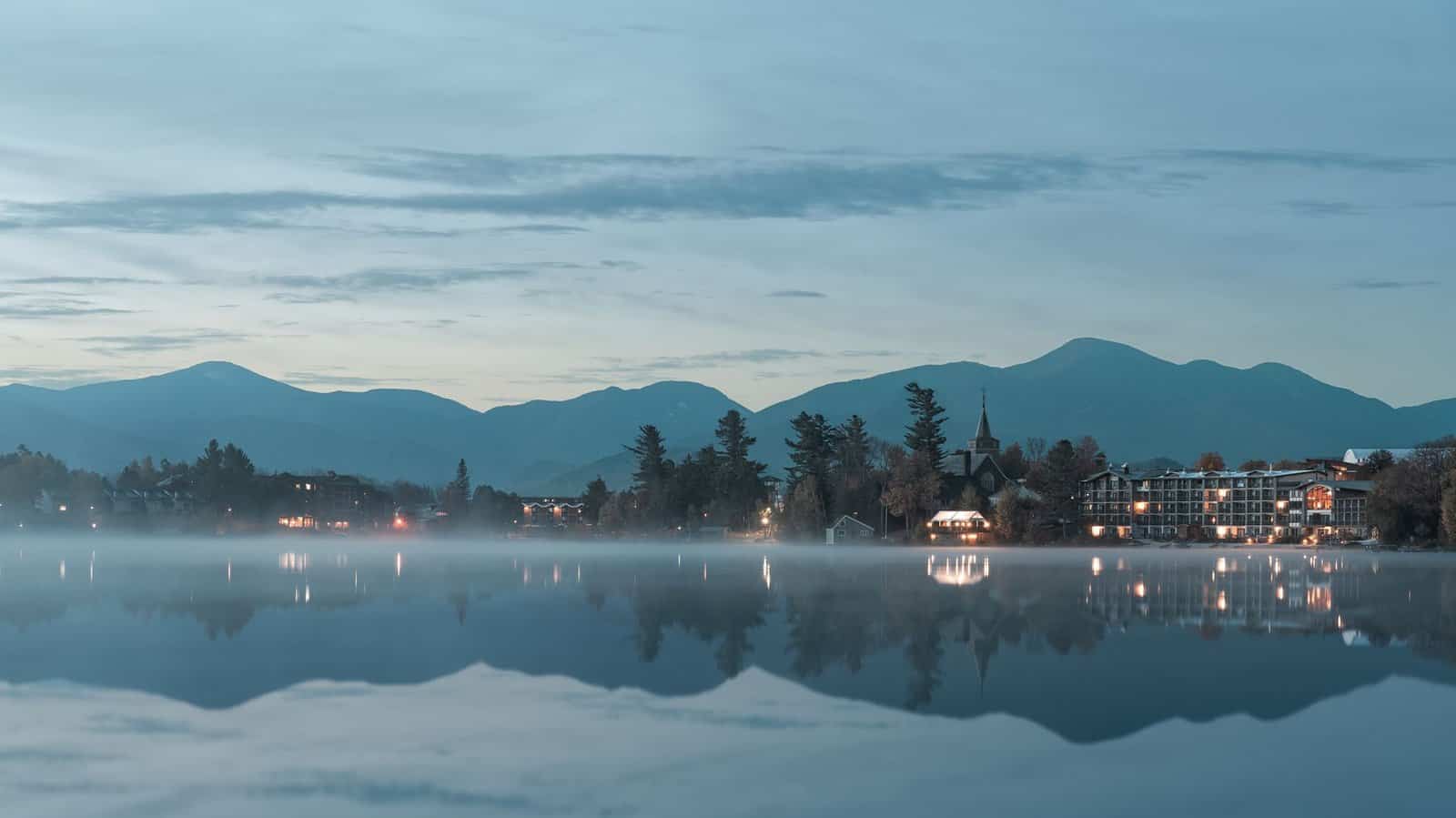
Mirror Lake, the namesake of Lake Placid’s most photographed feature, is the small lake in the village center — a 2.7-mile walking path circles it and provides the view of the mountains reflected in the calm water that appears in every Lake Placid photograph. The Olympic Museum on Main Street documents the 1932 and 1980 Games with the depth you’d expect from a permanent facility at the site itself — the Miracle on Ice section, with the actual game footage and the locker room recreation, is genuinely affecting even for viewers who weren’t alive in 1980. Admission is $15/adult.
Lake Placid lodging has the full range: the Mirror Lake Inn (a historic lakefront resort with exceptional service, $300–$500/night in peak season) at the top, and a range of independently owned inns and motels along Mirror Lake Drive running $140–$200/night in fall. The village’s main street — with independent restaurants, bakeries, and Adirondack outfitting shops — operates at a scale and quality level that the Olympic history keeps relevant. Lake Placid is a town that would be worth visiting even if the Olympics had never happened; the Games gave it the infrastructure and the international awareness that most Adirondack villages of 2,500 people don’t have.