Birmingham’s Giant Roman God Has Been Showing the City His Bare Backside for Generations
We may earn money or products from the companies mentioned in this post. This means if you click on the link and purchase the item, I will receive a small commission at no extra cost to you ... you're just helping re-supply our family's travel fund.
Key Takeaways
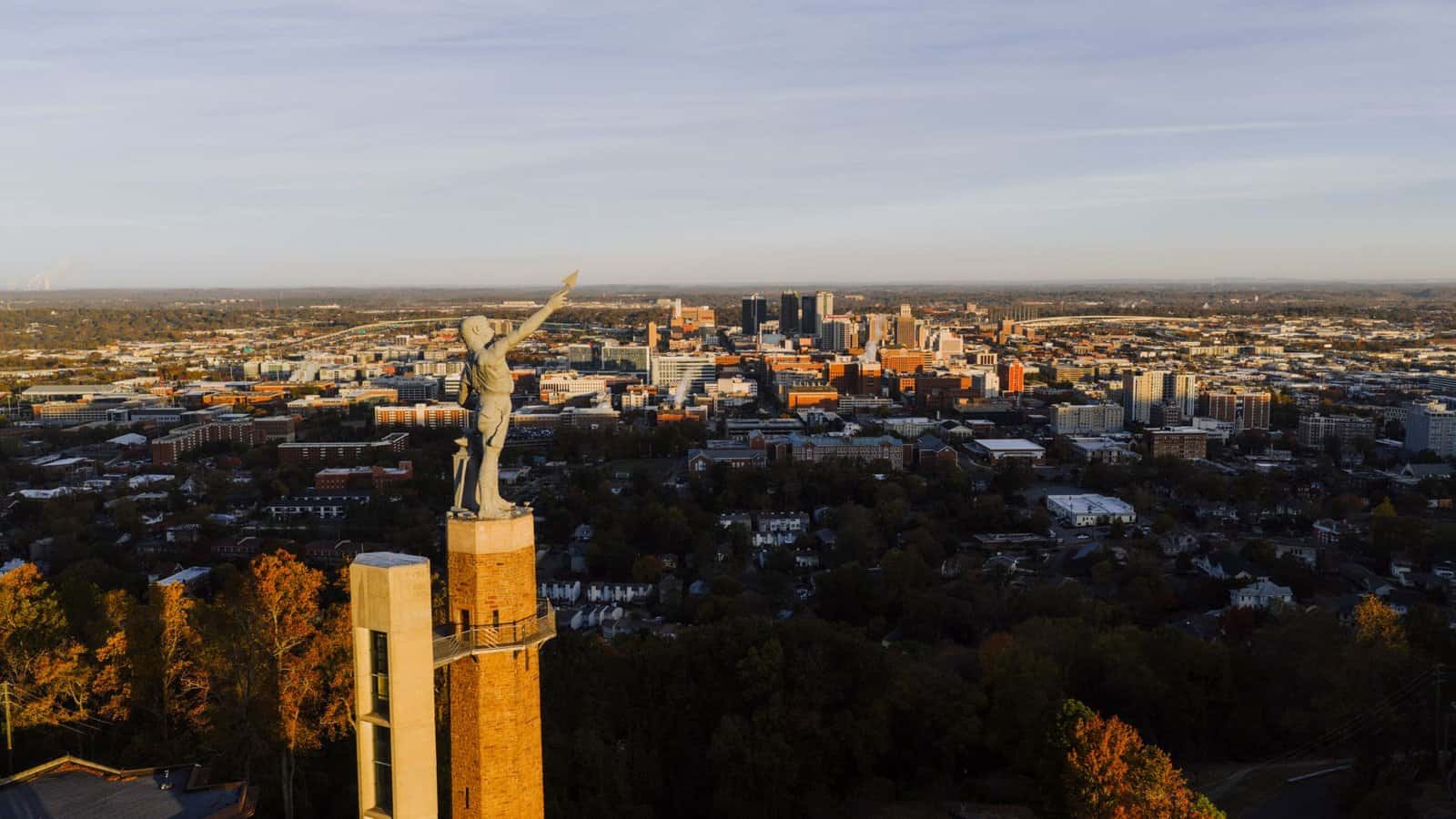
- Moretti designed Vulcan with a bare back.
- The statue stands 56 feet tall and weighs 101,200 pounds.
- The pedestal brings its total height to 180 feet.
- Vulcan represents Birmingham’s industrial roots.
- The park combines a museum, city views and outdoor space.
- Daily admission covers the Observation Tower and Museum.
What Is the Story Behind the Vulcan Statue Birmingham Alabama?
Birmingham created Vulcan as an industrial exhibit for the 1904 World’s Fair, not as a city monument. City leaders wanted the statue to show what the area could make from iron and steel.Birmingham’s industrial entry for the 1904 World’s Fair
By the 1880s, Alabama ranked fourth in the nation for iron and steel production. The Commercial Club chose Vulcan to represent that growing industry in October 1903. In November, the club selected Italian sculptor Giuseppe Moretti to shape the figure. The Commercial Club’s choice drew on an old Roman god with a clear tie to metalwork. Vulcan gave Birmingham a strong figure for the world fair, while the local iron industry supplied the material. The city’s industrial identity was already established before the statue became a landmark.The 11,000-pound head is one of 29 cast-iron parts, bolted together from inside without an internal frame.
Casting the iron figure for St. Louis
J. R. McWane’s Birmingham Steel and Iron Company cast the statue between January and March 1904. Workers used Sloss No. 2 pig iron, giving the sculpture a direct link to local production. The finished figure then traveled to St. Louis for its public debut. Vulcan stood at the Palace of Mines and Metallurgy, where he won the Grand Prize in the mineral department. The dedication took place on June 7, 1904, and the statue was christened with water from the Cahaba River. The event tied the city’s iron trade to a memorable local touch.| Date | Place or group | Milestone |
|---|---|---|
| October 1903 | Commercial Club | Vulcan chosen |
| November 1903 | Birmingham | Moretti selected |
| January-March 1904 | Birmingham Steel and Iron Company | Cast from Sloss No. 2 pig iron |
| June 7, 1904 | Palace of Mines and Metallurgy | Dedication and Cahaba River christening |
How Did Vulcan’s Bare Backside Become a Public Scandal?
Vulcan’s fairground years turned his exposed rear into a civic embarrassment and an advertising opportunity. The awkward contrast between a formal Roman god and fairground promotions made the statue an easy target for jokes.An awkward return and a long fairground stay
Vulcan returned to Birmingham in February 1905, but he did not go straight to a grand new home. He lay in pieces beside the Birmingham Mineral Railroad tracks for 18 months. Civic groups later placed him at the Alabama State Fairgrounds, where he stood from 1906 to 1935. His fairground look added to the confusion. Workers installed the right arm incorrectly, and the spear point went missing. Without the spear, his pose looked even less like the sculptor’s original plan.Advertising, overalls and a new home
Promoters used the statue to draw attention to fairground goods and events. Vulcan held a pickle jar, and a giant pair of overalls was painted on his body. Ads and cover-ups changed over time:- A pickle jar in his hand
- Coca-Cola advertising
- An ice cream cone
- Painted overalls covering his body
How Has Vulcan Changed Since 1939?
The traffic torch was a public safety signal, not Vulcan’s original attribute, and the restoration removed it. Its changing look reflects both Birmingham’s traffic campaign and later work to protect the statue.The traffic torch and its message
In 1946, a torch replaced the spear as part of a traffic-safety campaign. Red signaled a Birmingham traffic fatality, while green meant there had not been one. The beacon became a familiar sight above the city for decades. A 1990 engineering study found the statue at risk of collapse. Earlier changes had also altered the site: a 1971 modernization clad the pedestal in marble and enclosed the observation deck. Those updates changed how visitors saw the statue and its setting. An AL.com account of the traffic beacon explains how the green and red lights marked the campaign’s daily message. The torch came out during the 1999 renovation, and the spear point returned to Vulcan’s outstretched right arm.A major restoration returns Moretti’s pose
The Vulcan Park Foundation formed in 1999 to raise money for repairs, park renewal and the Vulcan Center. A $15.5 million campaign supported restoration and expansion. The work brought the statue closer to Moretti’s intended pose and improved the visitor site. Vulcan Park and Museum reopened in March 2004. Birmingham celebrated the statue’s 100th birthday there in June. In November 2006, the restoration received the National Trust for Historic Preservation Honor Award. The statue also joined the National Register of Historic Places on July 6, 1976. That recognition gives the Vulcan Park Foundation and future caretakers a lasting reason to protect its design and setting. Cast iron exposed to Red Mountain weather still needs careful preservation over time.What Can You See at Vulcan Park and Museum?
Vulcan Park combines the landmark overlook with an interactive museum, green space and a trail. You can pair Birmingham’s history indoors with views and open air outside.Museum exhibits and the landmark overlook
The park museum uses interactive exhibits to tell Birmingham’s story. You can learn how the city grew around iron and steel, then head outdoors to see the landmark above the city. The museum and overlook offer different ways to connect the statue with its home. The observation deck and park grounds give you places to frame Vulcan with Birmingham in the background. The grounds cover 10 acres, with room to walk, rest and enjoy the open setting. The view and light can change, so take your time finding a spot that works for your photo.Kiwanis Centennial Park and Vulcan Trail
Kiwanis Centennial Park opened in March 2018 as a $5.8 million expansion. Its plaza adds more outdoor space to the park, while the Kiwanis Vulcan Trail extends the visit beyond the main grounds. The trail runs two miles to Green Springs Highway. The added trail and green space make the site useful for more than a quick stop at the statue. If you want more ideas for fresh air across the state, explore this guide to outdoor adventures in Alabama. Set aside time for both the indoor interpretation and the outdoor setting, since they show different sides of the city’s story.How Much Does a Visit to Vulcan Park Cost?
Daily admission is $8 plus tax for adults, with lower rates for seniors, military visitors and children. The ticket rule depends on which parts of the park you plan to enter. Daily admission is required for the Observation Tower and Museum. Park grounds are free until 5 p.m.; after that, you need a ticket to enter the Park. All listed paid rates are before tax.| Visitor group | Daily admission | Ticket rule |
|---|---|---|
| Adults age 13 and older | $8 plus tax | Daily admission required |
| Seniors age 65 and older | $6 plus tax | Daily admission required |
| Military visitors | $6 plus tax | Daily admission required |
| Children ages 5-12 | $4 plus tax | Daily admission required |
Where Is Vulcan Park, and When Can You Visit?
Vulcan Park & Museum is at 1701 Valley View Drive in Birmingham, with park and museum hours of 10 a.m.-8 p.m. Sunday through Thursday and 10 a.m.-9 p.m. Friday and Saturday. Schedules differ for the plaza gates and trail parking lot. The Observation Tower elevator is closed for routine maintenance, so visitors must use the stairs. The park and museum, plaza and trail lot each have their own hours. Keep those differences in mind when you plan a visit.The Observation Tower elevator is closed for routine maintenance; visitors can reach the deck by stairs.
- Park and museum: Sunday-Thursday, 10 a.m.-8 p.m.; Friday-Saturday, 10 a.m.-9 p.m.
- Kiwanis Centennial Park Plaza gates: daily, 10 a.m.-8 p.m.
- Vulcan Trail parking lot: daily, 10 a.m.-6 p.m.
Conclusion
Vulcan’s value is both the iron landmark above Birmingham and the park that lets visitors explore the city’s story. You can keep your visit simple with a walk around the grounds or spend more time inside the museum and on the tower. The park connects Birmingham’s industrial past with a place to see the city today. Decide whether you want the museum and tower or only the grounds, then check the day’s schedule before setting out.FAQ
What is the story behind the Vulcan statue in Birmingham, Alabama?
Birmingham created Vulcan for the 1904 St. Louis World’s Fair to show its iron and steel industry. City leaders chose the Roman god of fire and forge as a fitting figure for local metalwork. Birmingham sculptor Giuseppe Moretti designed the statue, and a local company cast it from pig iron. The fair exhibit won the Grand Prize in the mineral department.
Is the Vulcan statue still in Birmingham?
Yes, Vulcan stands atop Red Mountain at Vulcan Park & Museum in Birmingham. The statue moved to the mountain after years at the Alabama State Fairgrounds. Its current site includes an observation deck, museum and park grounds. You can see the statue as part of the city’s skyline and learn about its industrial history nearby.
Is the Vulcan statue free?
The park grounds are free until 5 p.m., but the Observation Tower and Museum require daily admission. After 5 p.m., you need a ticket to enter the Park. Children under 5 and members enter free. Paid rates vary by age and visitor group, and each listed rate has tax added to it.
What is the most famous statue in Birmingham, Alabama?
Vulcan is Birmingham’s best-known symbol and its most recognizable statue. The iron figure represents the city’s historic iron and steel industry. He stands above Birmingham on Red Mountain, holding a spear point in his outstretched arm. His size and long history make him a clear landmark for visitors and residents alike.
Is Vulcan the largest cast iron statue in the world?
Yes, Vulcan is the world’s largest cast iron statue and stands 56 feet tall from toe to spear point. He weighs 101,200 pounds, and his pedestal adds another 124 feet to the full height. The statue is also the largest metal statue ever made in the United States, a scale that reflects Birmingham’s industrial past.
Where is the Vulcan statue located?
The statue stands at Vulcan Park & Museum, 1701 Valley View Drive, Birmingham, Alabama 35209. The site sits atop Red Mountain and includes the museum, observation deck and park grounds. You can use the street address for navigation. The observation deck is reached by stairs while its elevator remains closed for routine maintenance.
Why is Birmingham, Alabama so famous?
Birmingham became known for its iron and steel industry, which helped shape the city’s growth. Nearby mineral resources supported that work, and Vulcan represents those industrial roots. The statue was made for a world fair to promote the city’s metal production. Today, its place above Birmingham keeps that history visible to visitors.
When did the Vulcan statue stop having the green and red light?
The torch was removed during Vulcan’s 1999 renovation, and the statue returned to its spear-point pose. The torch had replaced the spear in 1946 for a traffic-safety campaign. Green meant there had not been a traffic fatality, while red signaled one. The beacon’s long run made it a memorable part of Birmingham’s skyline.