The O.K. Corral Gunfight Lasted About 30 Seconds. 7 Things Tombstone Visitors Should Know About What Really Happened
We may earn money or products from the companies mentioned in this post. This means if you click on the link and purchase the item, I will receive a small commission at no extra cost to you ... you're just helping re-supply our family's travel fund.
The most famous gunfight in the American West was over almost as soon as it began. On the afternoon of October 26, 1881, in Tombstone, Arizona Territory, the O.K. Corral gunfight lasted about 30 seconds, with roughly 30 shots fired at close range. Three men died. Three others were wounded. And the story has been retold, reshaped, and argued about ever since.
According to the O.K. Corral Gunfight Site’s history, the Earp brothers, led by Marshal Virgil Earp with Wyatt and Morgan, and their friend Doc Holliday confronted members of the Cowboys faction in a narrow vacant lot behind the O.K. Corral. When it ended, Billy Clanton and brothers Tom and Frank McLaury were dead, and Virgil, Morgan, and Doc were wounded. Wyatt walked away unhurt.
Tombstone has built its tourism around that half-minute. If you are visiting, here are seven things to know about what really happened.
What really happened at the O.K. Corral gunfight
Tombstone was a silver boomtown founded after prospector Ed Schieffelin found silver in the area in 1877. By 1881, it was one of the largest towns in the Southwest, with saloons, theaters, and a growing population. Tensions had built for months between the Earps, who represented town law enforcement, and a loose group of ranchers and outlaws known as the Cowboys, including the Clantons and McLaurys.
On October 26, after a night of poker, threats, and confrontations, the Earps and Holliday walked down Fremont Street to disarm the Cowboys, who were carrying weapons in town in violation of a local ordinance. Virgil reportedly called out, “Boys, throw up your hands, I’ve come to disarm you.” Seconds later, the shooting began.
1. It did not happen inside the O.K. Corral
Despite its name, the fight did not take place inside the O.K. Corral. It happened in a narrow vacant lot behind the corral, between the Harwood House and Fly’s Photography Gallery and Boarding House, off Fremont Street. The O.K. Corral’s rear entrance opened onto that area, which is how the gunfight got its name.
At the O.K. Corral Gunfight Site in Tombstone today, you can see the location, along with life-size figures placed where historians believe each man stood.
2. It was over in about 30 seconds
The gunfight was fast. In about 30 seconds, roughly 30 shots were fired at close range, with the two groups standing only a few feet apart. Accounts differ on who fired first, and that question was central to the legal case that followed.
That speed is one reason eyewitness accounts conflicted. Smoke, noise, and confusion made it hard for anyone to see exactly what happened.
3. Three men died, and three were wounded
Billy Clanton and brothers Tom and Frank McLaury were killed. Virgil Earp was shot in the leg, Morgan Earp was hit in the shoulder, and Doc Holliday was grazed. Wyatt Earp was not wounded.
Ike Clanton, Billy’s brother and one of the central figures in the conflict, ran from the fight and survived. Billy Claiborne, another Cowboy, also fled.
4. The Earps and Holliday were charged with murder
After the gunfight, Ike Clanton filed murder charges against the Earps and Holliday. Justice of the Peace Wells Spicer held a preliminary hearing that lasted about a month. Witnesses gave conflicting accounts of whether the Cowboys had surrendered or were drawing weapons.
In the end, Spicer ruled that there was not enough evidence to indict the Earps and Holliday, finding that they had acted within their duties as lawmen. The case did not go to trial.
5. The violence did not end there
The gunfight was the start of a deadly feud, not the end of one. In December 1881, Virgil Earp was ambushed and badly wounded, losing the use of his left arm. In March 1882, Morgan Earp was shot and killed while playing billiards in Tombstone.
Wyatt Earp then led a group, including Holliday, on what became known as the Earp Vendetta Ride, hunting down men he believed were responsible. Several men were killed. Wyatt later left Arizona and spent the rest of his life in other parts of the West, dying in Los Angeles in 1929.
6. Doc Holliday was a dentist with tuberculosis
Doc Holliday, born John Henry Holliday in Georgia, trained as a dentist before moving west, partly because of tuberculosis. He became known as a gambler and gunman and was a close friend of Wyatt Earp.
Holliday died of tuberculosis in 1887 in Glenwood Springs, Colorado, at age 36. His presence at the gunfight, carrying a shotgun under his coat, made him one of the most famous figures in Western history.
7. The legend grew decades later
For years after the gunfight, it was a local story more than a national legend. That changed in the 20th century. A 1931 biography of Wyatt Earp by Stuart Lake helped make him a national hero, though historians have questioned its accuracy. Hollywood followed with films like My Darling Clementine in 1946, Gunfight at the O.K. Corral in 1957, and later Tombstone in 1993 and Wyatt Earp in 1994.
These films shaped how most people imagine the gunfight, often dramatizing events and simplifying the people involved. When you visit Tombstone, you will see that legend everywhere, but the history is more complicated.
What to see in Tombstone today
Tombstone calls itself “The Town Too Tough to Die,” and its historic district is a National Historic Landmark. Here is what to see:
- O.K. Corral Gunfight Site: The site of the gunfight with daily reenactments, exhibits, and Fly’s Photography Gallery.
- Allen Street: The main street, with wooden boardwalks, saloons, and shops in historic buildings.
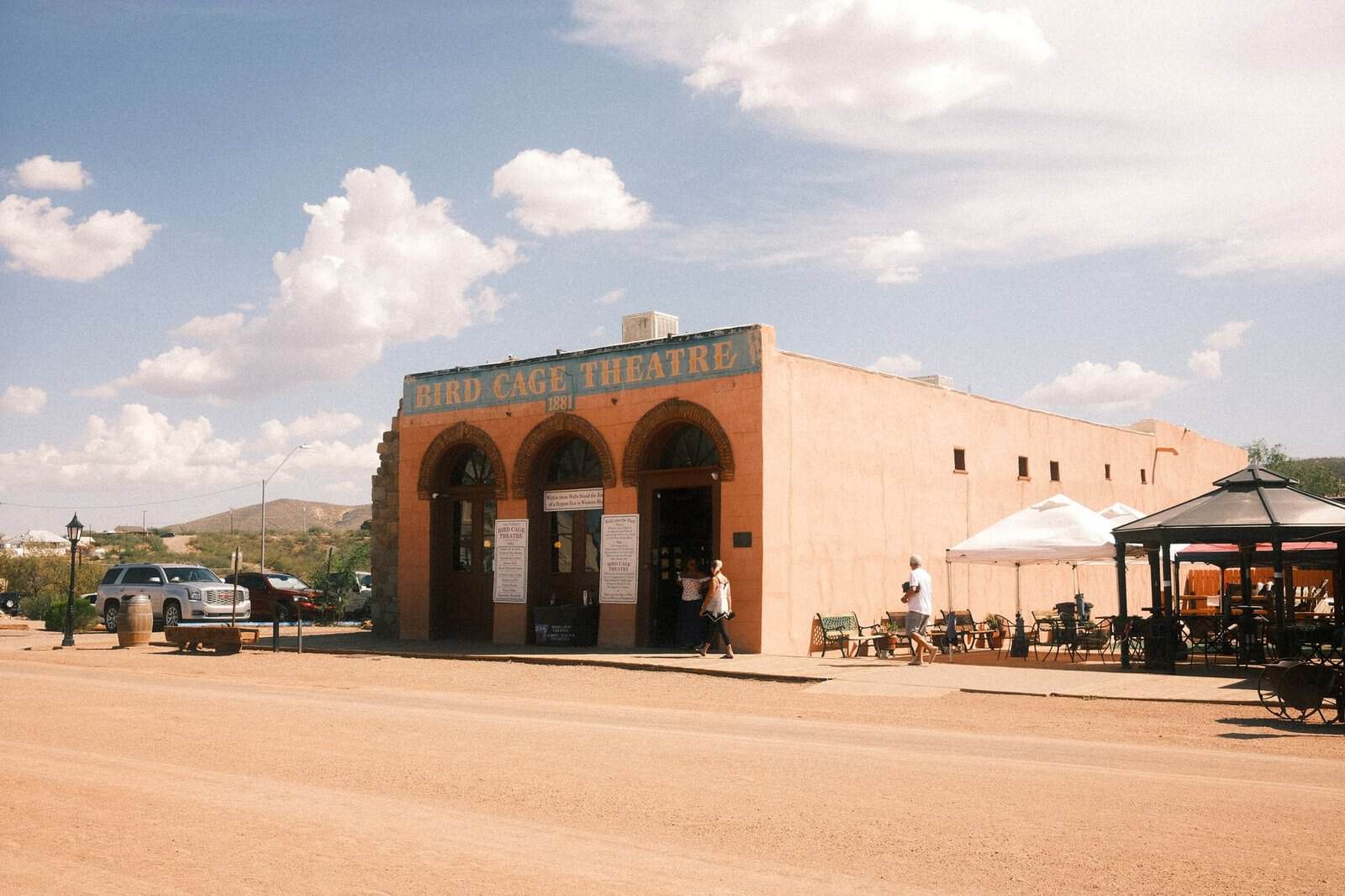
- Bird Cage Theatre: A former saloon, theater, and gambling hall from the 1880s, now a museum with original artifacts.
- Tombstone Courthouse State Historic Park: The 1882 courthouse, now a museum on the town’s history.
- Boothill Graveyard: The cemetery where Billy Clanton and the McLaury brothers are buried, with humorous and grim epitaphs.
- Tombstone Epitaph: One of Arizona’s oldest newspapers, with a small museum about its history.
Many attractions charge admission. Check current hours, especially outside peak season.
Reenactments and shows
Several venues in Tombstone stage gunfight reenactments daily. The O.K. Corral show is the best-known, but other shows on Allen Street and around town offer their own versions. Some are historically focused, while others are more theatrical.
Reenactments can be loud, so warn children and anyone sensitive to noise. Arrive early for good seats.
Helldorado Days and other events
Tombstone hosts events throughout the year, including Helldorado Days in October, near the anniversary of the gunfight, with parades, reenactments, and costumes. If you want a lively atmosphere, plan around these events. If you prefer a quieter visit, go on a weekday outside event weekends.
When to visit
Tombstone sits at about 4,500 feet in southeastern Arizona. Fall, winter, and spring bring mild weather, making it a good escape from colder places. Summers can be hot, though not as hot as Phoenix or Tucson.
Late fall is a particularly good time: comfortable temperatures, fewer crowds than spring, and the anniversary events of late October.
Getting there
Tombstone is about 70 miles southeast of Tucson, roughly a 75- to 90-minute drive. From Tucson, take Interstate 10 east to Benson, then Arizona Route 80 south. You can combine a visit with Bisbee, a historic mining town about 25 miles south, or with Kartchner Caverns State Park near Benson.
Who the Cowboys were
The word “Cowboys” in 1880s southeastern Arizona did not simply mean cattle workers. Locally, it referred to a loose network of ranchers, rustlers, and outlaws, some of whom were accused of stealing cattle across the border in Mexico and robbing stagecoaches. The Clantons and McLaurys ran ranches in the area and were associated with this group, though historians still debate how deeply each man was involved in crime.
Politics added to the conflict. The Earps were generally aligned with Republican business interests in town, while many ranchers in the surrounding county leaned Democratic. Cochise County Sheriff Johnny Behan, a rival of Wyatt Earp, was seen as friendlier to the Cowboys. Those divisions shaped how people in Tombstone viewed the gunfight and the hearing that followed.
A half-day Tombstone itinerary
Arrive in the morning and start at the Tombstone Courthouse State Historic Park for background on the town and the gunfight. Walk Allen Street and stop at the Bird Cage Theatre. Catch a midday reenactment at the O.K. Corral Gunfight Site, then visit Boothill Graveyard on the north edge of town. Finish with lunch at one of the saloons on Allen Street before driving on to Bisbee.
Separating history from legend
As you explore Tombstone, keep a few things in mind:
- The Earps were not purely heroes, and the Cowboys were not purely villains. Both sides had complex motivations, and local politics played a role.
- Accounts conflict. Witnesses at the time disagreed about key details, and later retellings added drama.
- Movies are not history. Films took liberties with timelines, characters, and dialogue.
- The town is part museum, part theme park. Enjoy the shows, but read the exhibits to get the fuller story.
The bottom line
The O.K. Corral gunfight lasted about 30 seconds on October 26, 1881, but its story has lasted for more than a century. It happened in a vacant lot behind the corral, killed three men, led to a murder hearing that cleared the Earps and Holliday, triggered a cycle of revenge, and became a legend only decades later. When you visit Tombstone, you can stand where it happened, and with these seven facts in mind, you will know how much of the legend is real.