Allegheny National Forest Is the Northeast’s Largest—Yet Travelers Outside Pennsylvania Rarely Know It Exists
We may earn money or products from the companies mentioned in this post. This means if you click on the link and purchase the item, I will receive a small commission at no extra cost to you ... you're just helping re-supply our family's travel fund.
Allegheny National Forest covers more than 500,000 acres in northwestern Pennsylvania, making it the largest national forest east of the Mississippi River outside the South, yet it draws a fraction of the visitors that flock to smaller, more famous Eastern parks like Shenandoah or the Great Smoky Mountains. The forest’s relative obscurity outside Pennsylvania has as much to do with regional marketing as with the landscape itself, which includes the Allegheny Reservoir, old-growth forest remnants, and one of the largest herds of free-ranging elk east of the Mississippi.
A Forest Built Around an Industry, Not a View
Allegheny National Forest was established in 1923 primarily to manage timber resources and watershed protection rather than to preserve a singular scenic feature the way many Western national parks were designated. That utilitarian origin has shaped its identity ever since: the forest permits oil and gas extraction on a significant portion of its acreage, since the region sits atop the historic Pennsylvania oil fields where the American petroleum industry began in the 1850s near Titusville, just outside the forest’s southern boundary.
This working-forest character, with active gas wells visible along some forest roads, has made Allegheny National Forest a harder sell for scenic tourism marketing than parks with pristine, extraction-free branding, even though the vast majority of the forest’s acreage remains undeveloped hardwood and hemlock forest that turns spectacular colors each October.
What’s Actually There
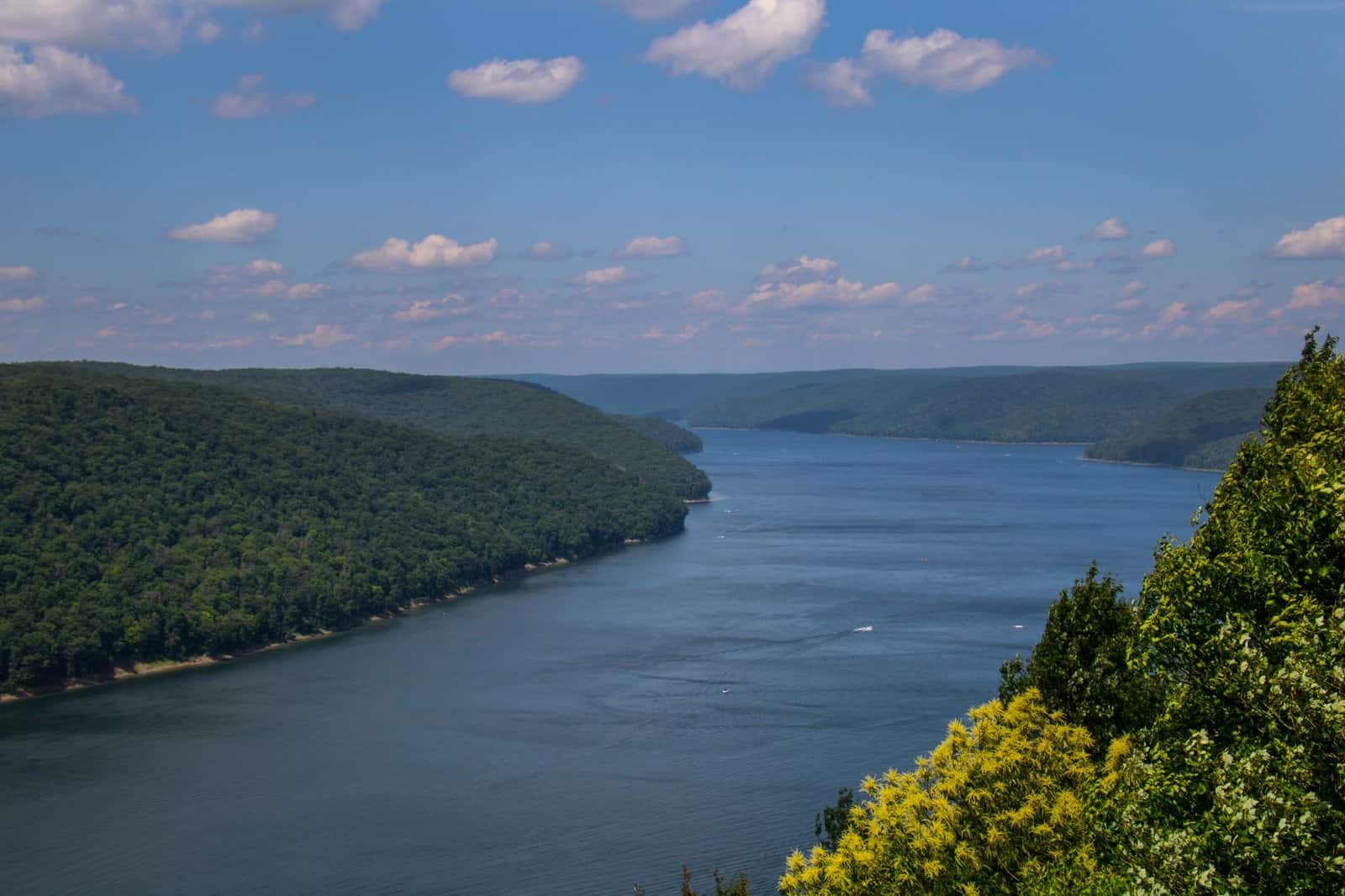
- The Allegheny Reservoir, created by the Kinzua Dam in 1965, offers boating and fishing across 12,000 acres of water spanning the New York-Pennsylvania border
- The Tionesta Scenic and Research Natural Areas preserve some of the last old-growth forest remaining in Pennsylvania, hemlock and beech stands that were never logged
- A free-ranging elk herd, reintroduced to Pennsylvania in the early 20th century after the native population was hunted to extinction, now numbers in the hundreds within and around the forest
- The forest contains over 600 miles of trails, including a segment of the North Country Trail, one of the longest hiking trails in the country
The elk herd draws a small but devoted following of wildlife photographers and viewers, concentrated particularly in nearby Benezette outside the forest’s boundary, during the fall rutting season when bulls bugle and spar for mates, a spectacle that has generated a modest but growing local tourism economy in an area that otherwise has little to draw visitors.
Why It Stays Under the Radar
Allegheny National Forest sits several hours from any major East Coast metro area — Pittsburgh is roughly two hours south, and it’s four or more hours from New York City or Washington, D.C. — which places it outside easy weekend-trip range for the population centers that drive most Eastern national park visitation. Its regional promotion has also historically been split among multiple entities, including Pennsylvania’s state tourism office and several county visitor bureaus, without the kind of unified national marketing push that the National Park Service gives to its own units, since Allegheny is managed by the U.S. Forest Service under a different, generally lower-visibility promotional structure.
The forest’s dual identity as both a working resource-extraction landscape and a recreation destination has also made it harder to market with a single clean narrative, unlike parks that can be sold purely on pristine wilderness. Forest Service officials have periodically discussed increasing recreation-focused marketing, but the agency’s mission and funding structure prioritizes multiple-use management over tourism promotion in a way the National Park Service’s mission doesn’t. The forest’s oil and gas leases also generate direct federal revenue that National Park Service units generally don’t produce, giving Allegheny National Forest a different budgetary relationship with the federal government than scenery-first destinations, one where extraction revenue partially offsets the cost of maintaining recreation infrastructure rather than tourism dollars alone funding the forest’s operations. That financial structure has made Allegheny more resilient to federal recreation budget cuts than parks that depend more heavily on entrance fees and congressional appropriations tied specifically to visitation numbers. Pennsylvania’s own state tourism promotion has increasingly highlighted the Allegheny region’s fall foliage and wildlife viewing in recent marketing campaigns, a modest but noticeable shift from decades of tourism materials that focused almost exclusively on Philadelphia, Pittsburgh, and the state’s Amish country attractions in Lancaster County, suggesting state officials may be beginning to recognize the promotional gap that has kept the forest underused relative to its scenic and recreational scale. Local outfitters and guide services operating near the forest, including canoe and kayak rental companies along the Allegheny Reservoir, have reported gradual but steady growth in bookings over the past decade, a slower-moving but genuine indicator that outdoor recreation demand in the region has been increasing even without the kind of dramatic viral attention that has reshaped visitation patterns at more famous natural landmarks elsewhere in the country. Fall foliage viewing specifically has become the forest’s single most reliable seasonal draw, with peak color typically arriving in early to mid-October and drawing visitors from Pittsburgh, Buffalo, and Cleveland who treat the drive as a manageable day trip or overnight rather than a multi-day vacation commitment. Winter visitation drops sharply once the leaves fall and snow begins accumulating on forest roads, leaving the reservoir and surrounding trails largely to a small population of dedicated cross-country skiers and ice fishers rather than the broader visitor base that arrives each autumn.
What Visitors Find When They Do Show Up
Those who do visit tend to report an experience closer to a quiet Adirondack lake trip than a crowded national park, with far fewer visitors competing for the same trails, campsites, and boat launches. Fall foliage season and elk rutting season in September and October represent the closest thing the forest has to a true peak crowd period, and even then, visitor density remains far below what comparable Eastern attractions see during their equivalent seasons.
Allegheny National Forest’s continued low profile means it functions as one of the more genuine remaining examples of an underused large-scale natural resource in the densely populated Eastern United States, a status that seems likely to persist given the structural and marketing reasons behind its obscurity rather than any lack of genuine scenic or recreational value.