The Palouse Has Two College Towns—June Is When This Region Shows Visitors Why They Keep Coming Back
We may earn money or products from the companies mentioned in this post. This means if you click on the link and purchase the item, I will receive a small commission at no extra cost to you ... you're just helping re-supply our family's travel fund.
The Palouse is the rolling grain country of southeastern Washington and adjacent north-central Idaho, a region that makes visitors pull over because the hills appear almost painted. Its appeal is not just the view. The landscape is tied to working wheat, lentil, pea, and canola fields, to weather, and to two university towns: Pullman, home to Washington State University, and Moscow, home to the University of Idaho. That mix gives an agricultural region a surprising cultural density.
The landscape is agricultural geometry
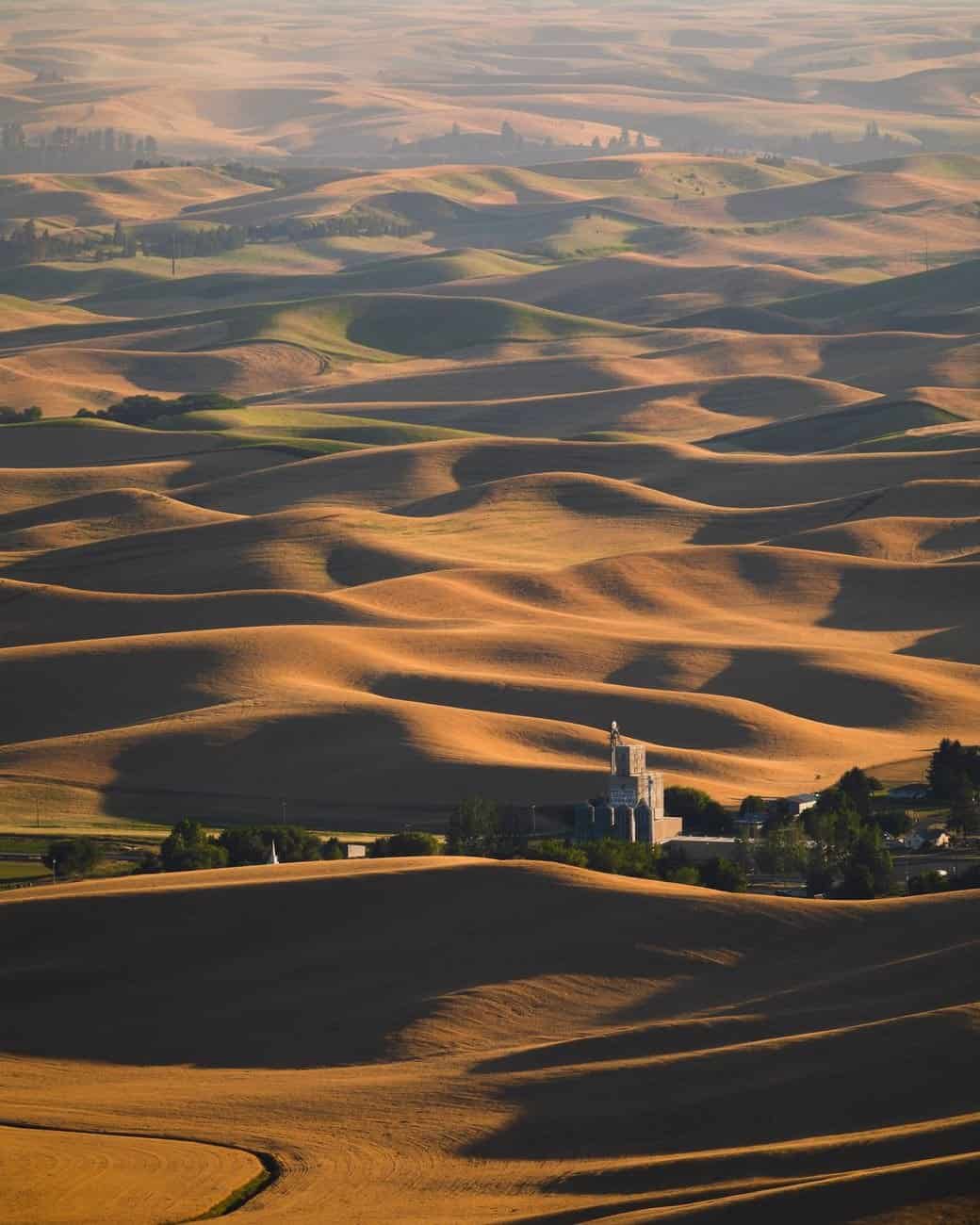
Pullman and Moscow sit roughly eight miles apart, close enough to share diners, concerts, games, and regional errands while remaining in different states. The hills are not natural lawn; their changing greens, golds, and browns follow planting, moisture, and harvest. June often delivers the most dramatic patchwork, but exact timing depends on the year. A traveler who arrives expecting a permanent screen-saver will miss the point of a landscape whose value comes from doing agricultural work.
Pullman and Moscow give it a year-round pulse
The best drives are slow ones on county roads, with safe pullouts and respect for private land. Steptoe Butte provides a high perspective in Washington, while back roads around Colfax, Pullman, Moscow, and the state line reveal the repeated folds at ground level. In town, the universities make the region feel less isolated than its population totals suggest. Coffee shops, bookstores, farm suppliers, student rentals, and sports calendars coexist in a way that feels specific to a college-and-farm economy.
A road trip with a calendar
The return-trip factor is seasonality. In summer the hills dry toward gold and harvest activity increases. In winter, the sky and open roads can feel enormous; in spring, mud and weather complicate the romantic version. The region asks visitors to drive with patience. Roads are working infrastructure for grain trucks and local residents, not a scenic course designed around a single car’s photo stops.
June is beautiful because farming is real
The Palouse rewards attention, but it does not offer nonstop attractions. That is a feature for people who want a landscape with room to think and a limitation for anyone needing a dense itinerary. Book in Pullman or Moscow, spend locally, and treat the farms as workplaces. The photo is free; the field, soil, and road system behind it are not.
- Aim for June greens but accept that weather controls the exact peak.
- Use designated pullouts and never enter planted fields for a picture.
- Split time between Pullman and Moscow rather than choosing one as the entire region.
- Check university event calendars before booking lodging on game weekends.
- Carry water, fuel, and a paper backup map for rural drives.
What an attentive visit changes
The most useful way to approach this subject is to separate a memorable image from the system that produces it. The landscape is agricultural geometry is not an abstract theme; it is visible in schedules, property choices, staffing, roads, and the small decisions that residents make every week. A traveler does not need expert credentials to notice those connections. They do need enough time to look past the quickest version of the story and enough humility to avoid mistaking a short stay for total knowledge.
That distinction changes the itinerary. Instead of trying to collect every landmark, leave room for a normal block, a local meal at an ordinary hour, a bus or walk that follows daily movement, and a conversation in which the visitor listens more than they perform expertise. The point is not to claim an insider identity after a weekend. It is to come away with a better question about how place, work, culture, and money fit together.
Pay attention to the operating details
Operating details often explain more than promotional language. Look at when a street is busy, how long the drive actually takes, what people carry out of shops, where public space ends, and whether an attraction depends on a fragile landscape or a workforce with limited housing. These observations make travel more interesting because they restore cause and effect. A beautiful view can remain beautiful while becoming less anonymous.
There is also a practical benefit. Travelers who plan with context are less likely to arrive at the wrong hour, overbook a day, ignore seasonal constraints, or spend all their money inside the most expensive corridor. They can make choices that are kinder to their own energy and more useful to the places hosting them. The result is not a perfect trip. It is a trip that has a chance to be both enjoyable and proportionate.
This approach also leaves room for disagreement and change. Local conditions evolve: a storefront closes, a route gains service, a storm alters access, a new employer shifts demand, or a community decides that an old arrangement no longer works. Treating a destination as fixed makes every update look like a disappointment. Treating it as a living place makes updates part of the reason to return. The traveler’s job is not to preserve a preferred image of somewhere else. It is to arrive prepared, observe carefully, and accept that the people who live there have a longer relationship with its future. That is why a return visit can be more valuable than a larger checklist: familiarity makes the changes visible, and it makes a guest less likely to confuse novelty with importance. It can also make a traveler more patient with an imperfect day, more considerate about capacity, and more willing to find value outside the single attraction that originally prompted the trip. Over time, this habit produces a more durable travel memory: not just a record of where someone went, but a more grounded account of how the place worked while they were there. The added context makes recommendations more useful because it explains who benefits, what is fragile, and why a detail that seems minor may shape a local day.
Return for the view, stay for the scale
The Palouse keeps people coming back because the view changes without becoming less itself. The hills look spectacular in June, but the deeper attraction is seeing an agricultural region and two university towns operate together. It is a place where the scenery is not decoration. It is the surface of a working economy.