
Middletown Iowa Lead Azide Detonation: What We Know
We may earn money or products from the companies mentioned in this post. This means if you click on the link and purchase the item, I will receive a small commission at no extra cost to you ... you're just helping re-supply our family's travel fund.
The U.S. Army plans two controlled detonations of unstable lead azide near Middletown on November 20. Possible lead-containing particles are the main public-health concern. The operation is scheduled for about noon at the Iowa Army Ammunition Plant. Residents have limited time to prepare, and the short public notice has raised concerns about people who may live beyond the immediate area.
Potential exposure is a risk to assess, not proof that anyone has been harmed. Residents also want clear answers about notice, cleanup, possible effects on water and food, and who will be accountable. Those questions matter even before officials confirm where particles may settle. The key question for residents is where particles could travel and what precautions apply.
Key Takeaways
- The Army plans two detonations near Middletown around noon on November 20, 2026.
- Lead-containing particles may disperse in air and settle on the ground.
- Possible exposure does not confirm harm or contamination.
- Residents should follow current Army instructions for their location.
- The Army plans monitoring and voluntary soil testing after the operation.
What We Know About the Middletown Iowa Lead Azide Detonation
The Army says moving degraded lead azide could trigger an uncontrolled detonation. Slight friction or movement could set off volatile crystals, so the Army considers transport unsafe.
The material has been stored at the Iowa Army Ammunition Plant for roughly 20 years. A March 2026 inspection found its ethanol-and-water bath had evaporated, leaving crystals. Lead azide is a primary explosive used to start other munitions. The Army plans two detonations of 68 barrels at about noon Friday, November 20, 2026.
The Army considers in-place detonation by Explosive Ordnance Disposal experts its safest way to eliminate the hazard.
The blasts will happen in rapid succession. Residents may hear loud noise, feel ground vibrations, and see a dust plume. The Army says the operation is coordinated with the EPA under the Resource Conservation and Recovery Act.
American Ordinance LLC operates the plant and was the anticipated recipient of a September 9, 2025, subcontract for lead azide neutralization. That documented role does not establish fault or explain the evaporated bath. The confirmed contractor detail establishes a role in the operation, not a finding about what caused the bath to evaporate.
Where Could Lead Dust Travel?
The Army’s initial map showed a potential airborne area up to 20 miles wide and a separate ground-deposition area up to 10 miles wide. Both are projections, not confirmed boundaries for lead-containing particles.
Weather can change where the plume moves and where dust settles. The Army says airborne particles may disperse and deposit on the ground, where lead can persist in soil and sediment.
The Army’s initial plume projections
| Map category | Initial projection | Geographic or timing detail |
|---|---|---|
| Airborne exposure | Up to 20 miles wide | Burlington to well north of the Quad Cities; November 15 map extended north through Muscatine |
| Ground deposition | Up to 10 miles wide | Near Burlington to north of Wapello and New Boston |
| Map updates | 48 hours and 6 hours before | Hourly until detonation, then a final estimate |
The November 15 projection came five days before the planned detonation. The Army’s public advisory on map updates outlines the planned schedule.
What the owner’s map labels show
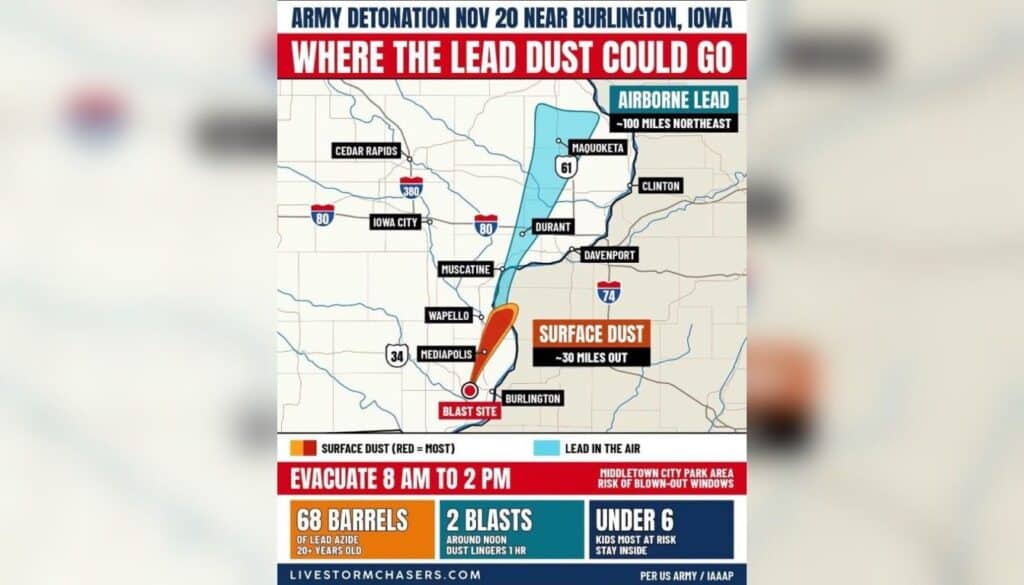
The owner’s image labels airborne dust as “~100 miles northeast” and surface dust as “~30 miles out,” farther than the Army’s initial projections. It also labels two blasts around noon, 68 barrels, material “20+ years old,” dust lingering “1 hr,” and children under 6 as most at risk.
The image includes an 8 a.m. to 2 p.m. evacuation notice. Its labels are not an independently verified forecast. National cancer figures also do not prove an Iowa ranking: U.S. incidence was 453.4 cases per 100,000 people in 2019-2023, versus 450.9 in metro counties and 466.6 in non-metro counties.
Water, plants, animals, and food are possible pathways to monitor, not confirmed contamination. Residents should use the latest location-specific Army projection rather than treating either map as a guarantee of where dust will settle.
What Should Residents Do Before and After the Detonation?
The Army advises people in affected areas to stay indoors during the potential exposure period if they cannot leave beforehand. Lead exposure can come from breathing particles or touching dust on surfaces. Young children are especially vulnerable to harm to the brain, nervous system, kidneys, and heart.
No known level of lead exposure is safe. The Army expects dust to remain in the air for no more than one hour, depending on wind speed.
Do not wet-clean outdoor surfaces until the Army determines that the air-exposure period has ended.
Reduce exposure during the plume period
The Army plans earthworks, wet soil, water mist, and air sampling to limit and monitor the plume. It also plans environmental sampling after the detonation. Follow these steps if the Army identifies your area:
- Stay indoors, and close windows and exterior doors.
- Set HVAC to recirculate or minimize outdoor air intake when safe.
- Avoid travel through affected areas.
- Wait for the Army’s end-of-exposure notice before wet-cleaning high-contact surfaces.
- Consider a car wash if your vehicle was parked outside.
The Middletown City Park evacuation recommendation covered 363 residents from 8 a.m. to 2 p.m. because ground vibrations could damage windows. People needing a place to stay were invited to the Armed Forces Reserve Center, 16815 DMC Highway 34, Middletown. Pets were welcome in carriers or on leashes.
Clean surfaces and follow up afterward
After the Army ends the air-exposure period, wet-clean play equipment, toys, tables, handrails, patios, decks, and exterior windowsills. The household hazard guide also explains why lead in dust and water deserves care.
Residents can request no-cost, voluntary soil testing by signing a Right of Entry agreement. The Army says it will remove and properly dispose of soil above regulatory lead thresholds.
As of November 18, 2026, the EPA had not answered questions about projected lead concentrations or whether it would offer blood tests. The CDC reference value for elevated lead in children is 3.5 μg/dL; a blood test measures lead but does not identify its source. For property damage, file Standard Form 95 within two years and call 913-684-3564. Keep records and use Standard Form 95 within two years if the detonation damages your property.
Conclusion
The immediate priority is to follow current, location-specific instructions and wait for the Army’s exposure-period update before cleaning. The maps depend on weather, so residents should check the latest local directions rather than rely on an older projection.
Possible paths through air, water, soil, plants, animals, or food are risks to monitor, not proof that contamination has occurred. The Army plans sampling and offers a way to request follow-up for individual properties. That local check matters when broad maps cannot show what reached a particular yard or surface.
Residents can use the Army’s voluntary soil-testing process to request follow-up for their property.


